
Why go
The grounds give context to Kanazawa's castle-town layout and make the scale of Maeda rule visible in the landscape.
Field Notes
Three surviving Edo-period structures provide useful anchors among the reconstructed buildings. Ishikawa-mon dates to 1788, Sanjikken Nagaya to 1858 and Tsurumaru Storehouse to 1848. The first two display the lead-covered roofs and raised white plaster lattice of namako walls associated with this castle. Looking at those materials helps distinguish its architectural character from castles known chiefly for a tall central keep.
The stonework offers another close-up route through the site. Tomuro stone was brought from a mountain quarry near Kanazawa, and its reddish and bluish tones are visible in the walls. Different sections preserve changing building techniques, while the decorative masonry in Gyokusen’inmaru Garden shows that retaining walls could also be composed for visual effect. Instead of treating every wall as a uniform defensive boundary, compare stone size, colour and finish as you walk. Those details make the castle’s long construction history visible even where buildings have disappeared.
Planning Notes
Suggested time on site: 45–90 minutes. Keep travel and waiting time separate from that estimate.
Timing noted for this stop: Daytime; verify current operating hours before travel.
Access reference: Kanazawa Station + bus. Check the final walking or connecting leg when choosing your route.
Location
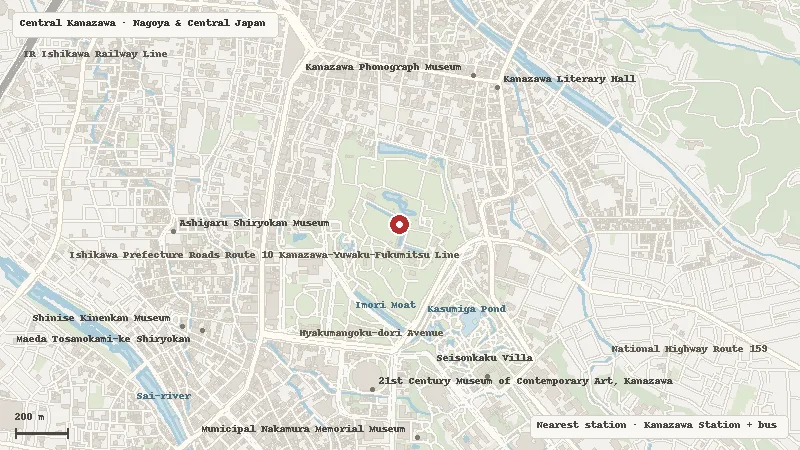
Map data © OpenStreetMap contributors