
Why go
Useful for an Osaka evening built around a district walk and dinner rather than a single landmark.
Field Notes
Dotonbori’s dining culture grew beside a theatre district. The canal began as a seventeenth-century project financed by local entrepreneurs; the name is generally linked to Yasui Doton, who died during the 1615 Siege of Osaka. In 1626, permission to move theatres to the new waterway helped turn its banks into an entertainment centre. Places to eat and meet followed the audiences, while wealthy customers could arrive by boat.
The famous Five Playhouses included kabuki venues, puppet theatres and a theatre known for mechanical spectacles. Takemoto-za staged the first performance of Chikamatsu’s Love Suicides at Sonezaki in 1703. Those older playhouses gradually disappeared as entertainment tastes changed, but restaurants remained central to the neighbourhood. The enormous signs now competing above the streets are a later expression of that need to attract an audience. On a walk, the canal, restaurants and showy façades make more sense together when seen as successive parts of a long-established entertainment economy.
Planning Notes
Suggested time on site: 1.5–3 hours. Keep travel and waiting time separate from that estimate.
Timing noted for this stop: Late afternoon into evening.
Access reference: Namba Station / Osaka-Namba Station - about 3 minutes to Ebisu Bridge. Check the final walking or connecting leg when choosing your route.
Location
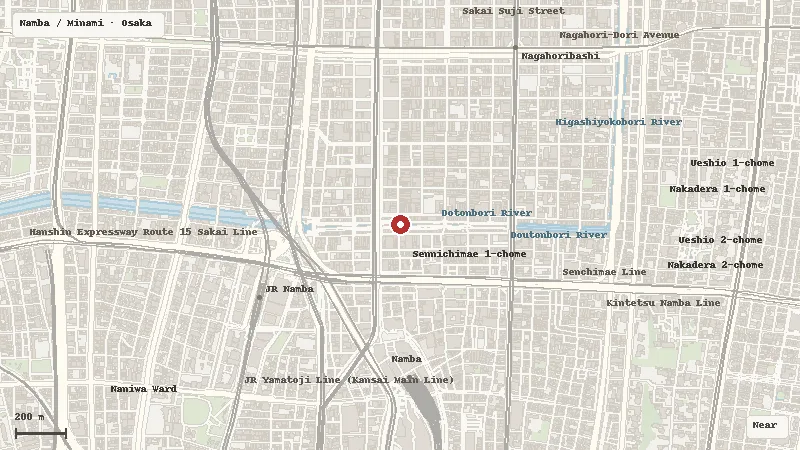
Map data © OpenStreetMap contributors