
Why go
According to the temple's foundation tradition, a Kannon image was found in the Sumida River in 628. Enter through the famous gate and approach, then give worshippers space at the main hall. Nakamise shops, outer grounds and hall follow different schedules; check the temple if the hall itself is essential to your visit.
Field Notes
The temple’s great age should not be mistaken for the age of every building. Its main hall was destroyed in the air raid of March 1945 and rebuilt in 1958 through donations from followers around Japan. The present Kaminarimon followed in 1960 after its predecessor had been lost to a nineteenth-century fire, while the five-storey pagoda was rebuilt in 1973. Nitenmon, on the eastern side of the precinct, preserves a different layer: the current gate dates to 1649. Looking beyond the main shopping approach therefore reveals both an Edo-period survivor and the architecture of postwar renewal.
The object at the centre of this active place of worship is deliberately unseen. Senso-ji describes its principal Kannon image as a hidden icon, a tradition it traces to the priest Shokai in 645. A visit is consequently an encounter with devotion around the image, rather than an opportunity to inspect the original statue described in the foundation story.
Planning Notes
Suggested time on site: 1.5–3 hours. Keep travel and waiting time separate from that estimate.
Timing noted for this stop: Early morning.
Access reference: Asakusa Station. Check the final walking or connecting leg when choosing your route.
Location
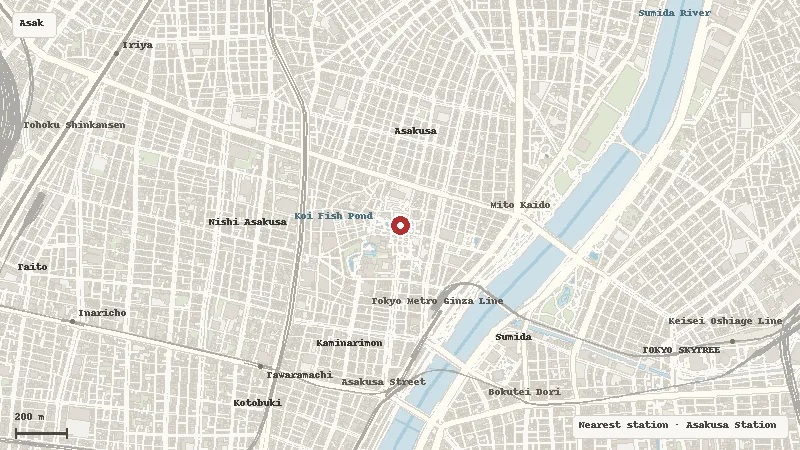
Map data © OpenStreetMap contributors