
Why go
A rewarding choice when garden composition and the relationship between architecture and landscape interest you.
Field Notes
Jisho-ji began as Ashikaga Yoshimasa’s Higashiyama retirement estate, with construction starting in 1482. Yoshimasa died in 1490 before seeing the pavilion completed, and the estate was subsequently made a Zen temple. The familiar Silver Pavilion name became established later, in contrast with Kinkaku-ji. This history places the garden within a former residence shaped by artistic interests as well as religious practice.
The Togudo, completed in 1486 as Yoshimasa’s personal Buddha hall, is another important survivor. It and the pavilion escaped a fire that destroyed most of the precinct in 1550. The temple’s account also connects Yoshimasa’s circle with art collecting, developing shoin-style interiors and tea practice, while Saiho-ji provided a model for the wider garden. That context encourages a broader look than the pavilion alone: the arrangement of buildings, garden and hillside reflects the cultural ambitions of a whole estate, subsequently preserved and reshaped as a temple.
Planning Notes
Suggested time on site: About 30 minutes for the usual garden visit; special building openings are separate. Keep travel and waiting time separate from that estimate.
Timing noted for this stop: Opening hour.
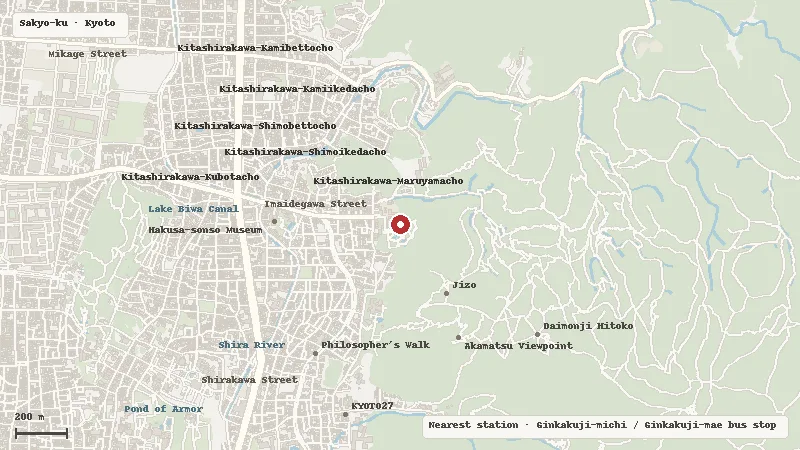
Access reference: Ginkakuji-michi / Ginkakuji-mae bus stop. Check the final walking or connecting leg when choosing your route.
Location
Map data © OpenStreetMap contributors