
Why go
The grounds reveal the scale of Kyoto's former court district while remaining part of the city's everyday public space.
Field Notes
The broad avenues and mature woodland are the result of a transformation after the court moved to Tokyo. Noble households followed the emperor, and their former Kyoto neighborhood deteriorated. A preservation project ordered in 1877 removed residences, organized roads and perimeter walls, and planted trees, including donations from people in Kyoto and elsewhere. Much of the apparently established greenery therefore belongs to the making of the modern garden rather than to an untouched palace forest.
Preparations for Emperor Taisho’s enthronement brought another major change, including the widening of Kenreimon-odori in 1914. Its scale was ceremonial, while the smaller paths through trees invite a more everyday kind of walk. The grounds opened as a National Garden in 1949 and later added recreation and nature-study areas. Read the residence-site markers alongside the avenues and planting: they help recover a densely inhabited court district within a landscape now valued for its openness.
Planning Notes
Suggested time on site: 2–3 hours. Keep travel and waiting time separate from that estimate.
Timing noted for this stop: Early morning; spring and autumn.
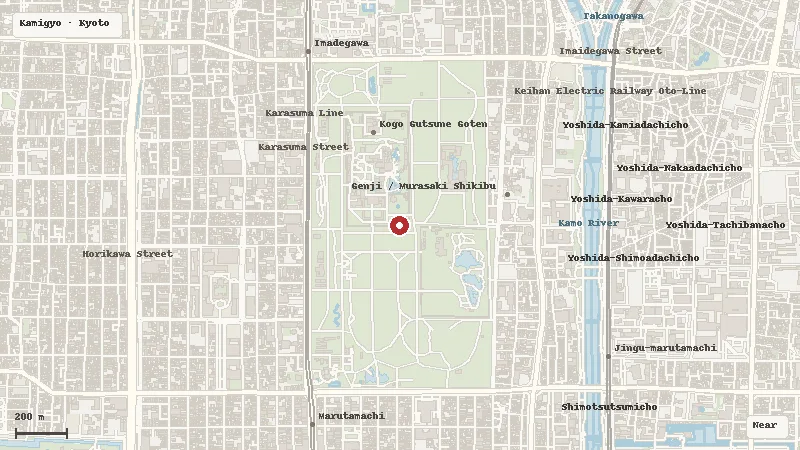
Access reference: Imadegawa or Marutamachi Station; multiple gates around the garden. Check the final walking or connecting leg when choosing your route.
Location
Map data © OpenStreetMap contributors