
Why go
Its small scale makes the relationship between houses, fields and mountain setting easy to read in a short walk. Because Suganuma remains a village rather than a recreated display, the gassho roofs are best understood as part of a lived settlement pattern.
Field Notes
Suganuma is one of the small gassho-zukuri settlements of Gokayama and forms part of the UNESCO World Heritage property shared with Ainokura and Shirakawa-go. The village sits on limited level ground in a narrow mountain valley, where winter snow, steep slopes and relative isolation shaped both settlement form and architecture. Its steeply pitched thatched roofs are practical responses to heavy snow, while the large attic spaces created beneath those roofs supported household work as well as storage.
The village’s small scale is one of its strengths. Houses cluster tightly above the river, surrounded by fields, forest and mountain slopes, making the relationship between buildings and available land easy to understand on foot. Several surviving houses date from the late Edo to early Meiji periods. They were built for the needs of families living and working in this environment rather than arranged later as an outdoor architectural display.
Across Gokayama, gassho-zukuri attics were used for activities including sericulture, and the region was also known for saltpeter production. The vertical interior volume of the houses therefore had economic value. Museums in Suganuma interpret aspects of this life, but individual buildings may close for repair or use, and visitors should not assume that every interior in the village is publicly accessible on every day.
UNESCO recognition emphasizes adaptation to environment and the preservation of social and economic systems, not simply the picturesque appearance of thatch. Modern roads have reduced the physical isolation of Gokayama, but the compact setting still reveals why land had to be used efficiently and why snow-country buildings developed such distinctive profiles.
Suganuma remains a living community. Even where particular houses operate as visitor facilities, other homes and spaces are private. The village should therefore be experienced slowly and respectfully, with attention to public paths and current access notices. It is also important to keep Suganuma distinct from nearby Ainokura and from Shirakawa-go: all three share gassho-zukuri traditions, but they are separate settlements with different scales, routes and visitor facilities. The value of Suganuma lies precisely in seeing one compact village as its own place rather than treating the World Heritage property as a single interchangeable attraction.
Planning Notes
Suggested time on site: 60–150 minutes. Keep travel and waiting time separate from that estimate.
Access reference: World Heritage Bus to Suganuma / Gassho-no-Sato. Check the final walking or connecting leg when choosing your route.
The official Suganuma listing sets a 16:00 parking-entry cutoff and asks visitors to avoid after-sunset or early-morning stops. The preservation operator’s August 2, 2026 notice closes the Saltpeter Museum fromJuly 31 until further notice for repairs; it explicitly says the Folk Museum and observation parking continue operating. This is a component closure, not a closure of the whole residential village.
Location
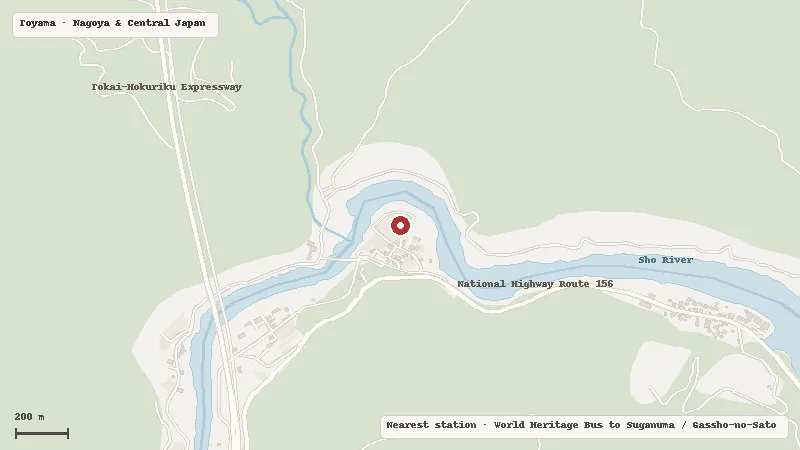
Map data © OpenStreetMap contributors