
Why go
Ainokura's relatively small scale makes the relationship between architecture and mountain geography easy to see. The steep roofs, close-set homes and river-valley terrace are part of a living settlement, not simply a collection of preserved buildings.
Field Notes
Ainokura is the larger of Gokayama’s two World Heritage gassho-zukuri villages and remains a living mountain settlement rather than a reconstructed open-air museum. UNESCO inscribed it in 1995 together with Suganuma and Shirakawa-go. The steeply pitched thatched roofs give the village its famous silhouette, but their form is rooted in practical needs: heavy snow must slide away, while the large attic volume created beneath the roof provides useful interior space.
The architecture also reflects household industry. Gokayama communities developed under relative isolation in narrow mountain valleys where flat land was scarce and families needed to use buildings efficiently. Upper floors and attic spaces supported activities such as sericulture, while the wider region was also known for saltpeter production. Ventilation, steep roof geometry and vertical interior organization therefore served economic functions in addition to weather protection.
Ainokura remains inhabited, and that point is essential to understanding both its value and its visitor rules. Traditional houses function variously as homes, inns, workshops and small museums. Preserving thick thatch, timber frames and communal spaces is expensive and labor-intensive, so tourism has become part of the contemporary economy without turning every doorway into public space. Quiet behavior and respect for private property are necessary precisely because the village is still lived in.
The mountain setting makes the settlement pattern especially clear. Forest rises sharply around the basin, while fields and roads occupy the limited terrace between houses. From higher viewpoints, the relationship among roofs, farmland, slopes and access routes is easier to read than from a single street. Snow transforms that geometry in winter, but also makes walking and transport more demanding.
Improved roads have ended much of the physical isolation that shaped historic Gokayama, yet the village still preserves the spatial logic of a snow-country community. Ainokura should also be kept distinct from Suganuma and Shirakawa-go; all three share gassho-zukuri traditions, but they differ in size, layout and visitor facilities. The most useful visit is an unhurried walk through public lanes and approved facilities, treating the settlement as a continuing community whose architecture still makes sense in its original mountain environment.
World Heritage status protects that continuing relationship between settlement and landscape, not merely the visual appearance of thatched roofs.
Planning Notes
Suggested time on site: 60–150 minutes. Keep travel and waiting time separate from that estimate.
Access reference: World Heritage Bus to Ainokura-guchi, then walk. Check the final walking or connecting leg when choosing your route.
Location
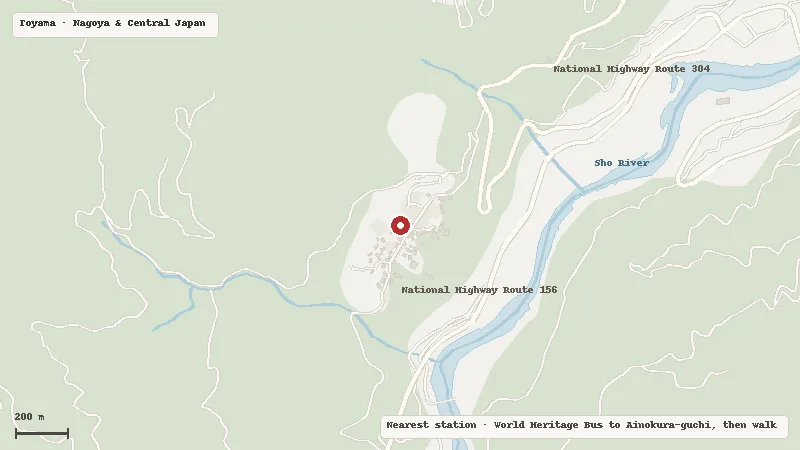
Map data © OpenStreetMap contributors