
Why go
The main hall and its celebrated stage are the visual anchor, yet the approach and temple grounds explain why this site has drawn pilgrims for centuries. Kiyomizu-dera traces its beginning to a sacred spring on Mount Otowa and a Kannon tradition, while its buildings have been rebuilt after repeated fires. Move beyond the first overlook to understand the hall, water and hillside as one setting. The temple's origin accounts are traditions, not modern eyewitness history.
Field Notes
The famous stage was built for more than looking over Kyoto. Kiyomizu-dera explains that it served as a setting for performances offered to Kannon, including court music, Noh, Kyogen and Kabuki. The religious focus lies inside the hall, so worship traditionally directs attention towards the sanctuary, with the landscape behind the worshipper. Remembering that orientation changes the experience of a space often approached mainly as a viewpoint.
Look beneath the stage to understand how the hillside was made usable. The present structure dates to the 1633 rebuilding and is supported by eighteen large zelkova pillars joined by penetrating horizontal timbers. This framework carries the veranda above the steep slope without relying on a broad level terrace. The main hall’s curved cypress-bark roof adds another material contrast with the exposed framework below. Together, performance space, sanctuary and timber supports explain how the temple’s architecture answers both its religious purpose and its mountain setting.
Planning Notes
Suggested time on site: 2–3 hours including the approach streets. Keep travel and waiting time separate from that estimate.
Timing noted for this stop: Early morning; blossoms late March–early April; autumn leaves mid-November–early December; peaks vary yearly.
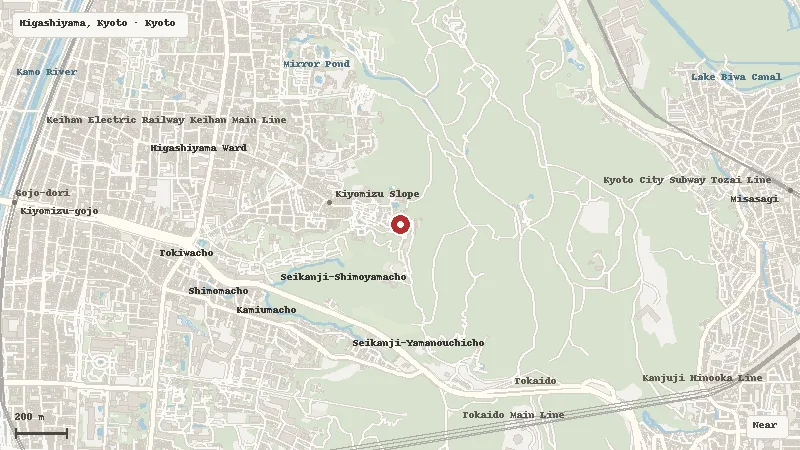
Access reference: Kiyomizu-Gojo Station - about 20–25 min walk; Kiyomizu-michi / Gojo-zaka bus stops followed by an uphill walk. Check the final walking or connecting leg when choosing your route.
Location
Map data © OpenStreetMap contributors