
Why go
The complex is strongest as an adaptive-reuse stop where the old port architecture remains visible while the buildings serve new functions. The railway display adds context for Tsuruga's role as a transport gateway rather than leaving the visit at architecture alone.
Field Notes
Tsuruga's Red Brick Warehouse offers a compact introduction to a port whose importance was tied to both sea routes and railways. The buildings were erected in 1905 for an American petroleum company, in a district connected with the movement of passengers and goods toward Vladivostok and continental Europe. Tsuruga's railway links and regular shipping services made the waterfront part of a much larger transport network. Seeing the warehouses in that context gives their industrial form a purpose: they belonged to the working infrastructure of an internationally connected town.
Their later uses trace changes in that economy. The operator's history records military storage and commercial warehousing after the original petroleum role, as well as repairs following heavy-snow damage. The north building, south building and brick boundary wall received national Registered Tangible Cultural Property status in 2009. Strengthening and restoration preceded their reopening to visitors in 2015. This sequence is useful to keep in mind while exploring: the attraction's modern functions are another chapter in the life of storage buildings that have repeatedly been adapted, rather than an attempt to return every space to its original use.
Look at the building fabric before moving straight to the displays. The complex consists of two single-storey structures with English-bond brickwork, timber roof framing and tiled roofs. Their present arrangement divides the north building into a diorama attraction and the south building into a restaurant space, with an open garden completing the visitor setting. This makes it possible to combine industrial architecture with a meal, but the two interiors have different purposes. Treat the buildings, garden and exhibition as related parts of the site, allowing time to appreciate how the surviving warehouse shell accommodates its newer public uses.
The large railway-and-port model is the most detailed introduction to the historical townscape. Around twenty-seven metres long, it reconstructs streets at approximately one-eightieth scale using a historical map of Tsuruga at the time of the 1945 air raid as a reference. Trains, moving ships and cars animate the transport story, and an upper viewing deck provides another perspective. Look for the relationship between rail alignments, harbour activity and the built-up town instead of watching only the locomotives. That broader view makes the model particularly useful before exploring the surrounding port district, where the warehouse itself is one surviving piece of the larger historical landscape.
Planning Notes
Suggested time on site: 60–120 minutes. Keep travel and waiting time separate from that estimate.
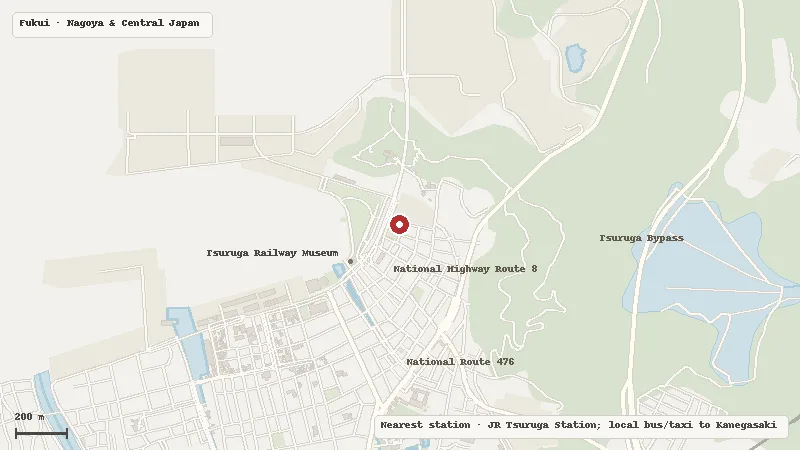
Access reference: JR Tsuruga Station; local bus/taxi to Kanegasaki. Check the final walking or connecting leg when choosing your route.
The operator’s October 1, 2026 notice specially opens the complex on Wednesday October 14 and closes it Thursday October 15; Diorama Hall hours remain 09:30–17:30, last admission 17:00. The current year-end closure is December 30–January 2. Groups of 15 or more should fax the group-visit form; the discount threshold is separately 20. Coach parking requires reservation. The building-wide 22:00 value is not Diorama Hall closing time.
Location
Map data © OpenStreetMap contributors