
Why go
The complex shows Kurashiki's industrial history in buildings that remain actively used instead of frozen as ruins. Brick walls, courtyards and ivy create a strong contrast with the nearby white-walled merchant streets, adding another layer to the city's architectural story.
Field Notes
Kurashiki Ivy Square gives the city's canal-side sightseeing a different architectural texture. Its red-brick buildings and climbing greenery belong to the former Kurashiki Spinning factory, adapted into a complex of accommodation, dining and cultural spaces. The redevelopment preserved as much of the factory's exterior and established trees as possible. Walk through with an eye for the relationship between the low industrial buildings and open spaces, rather than reading the site simply as a picturesque hotel. The original factory buildings received recognition as modernization industrial heritage in 2007.
The factory was constructed in 1889, and the later transformation responded to a very different pressure: the growing number of visitors to Kurashiki's historic district during the 1960s. The operator's history describes requests from the city and local residents for more accommodation and dining capacity. Architect Shintaro Urabe retained the working-era exterior and basic structure while introducing a large courtyard beside a pond. This gives the redevelopment a clear cultural interest of its own, showing how an industrial property could remain legible while acquiring a new public life.
For the strongest connection to the site's original purpose, include the Kurabo Memorial Hall. It occupies a raw-cotton storehouse dating from the company's early years, converted into a museum in 1969 for its eightieth anniversary. Photographs, models, documents and paintings place the firm's development within the history of Japanese spinning. The displays move from Meiji-period machinery and founding documents through the Taisho years, depression and war, then postwar recovery and diversification. A final chronology brings those separate rooms together, making this a useful stop before returning to the courtyards.
The rest of Ivy Square can be approached selectively. The operator lists craft and local-product shops alongside restaurants and a pottery workshop, including Bizen-ware and decorating experiences. Those activities let a visit extend beyond looking at buildings, but a workshop, museum visit and hotel stay are separate choices. Decide whether the priority is industrial history, a meal or making something, then check the relevant facility's arrangements. Even when time is limited, pairing the brick exterior with the former cotton warehouse provides a focused introduction to Kurashiki's manufacturing identity within its better-known historic sightseeing district.
Planning Notes
Suggested time on site: 60–120 minutes. Keep travel and waiting time separate from that estimate.
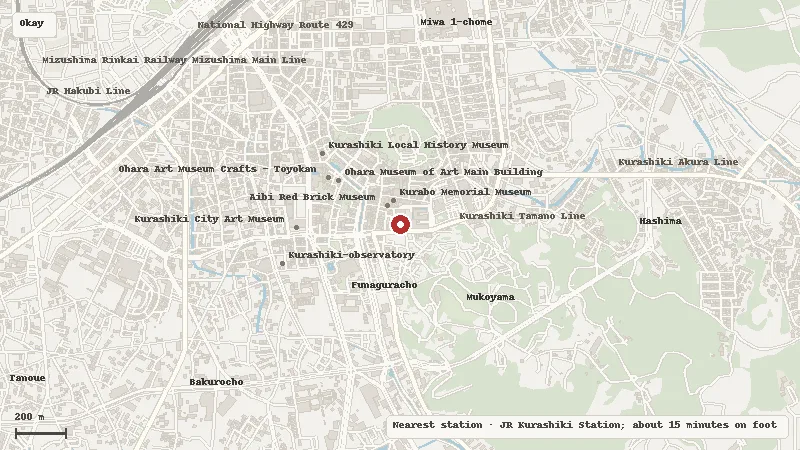
Access reference: JR Kurashiki Station; about 15 minutes on foot. Check the final walking or connecting leg when choosing your route.
Aibi pottery offers Bizen and hand-building sessions beginning at 11:00, 13:00 or 15:00 by telephone reservation. Bizen takes about two hours and hand-building about 90–120 minutes. Wheel sessions are arranged within 09:00–16:00 and take about thirty minutes per participant. The workshop is open 09:00–17:30; other tenants and the hotel follow their own arrangements. These are optional activity durations, not a replacement for the general complex visit estimate.
Location
Map data © OpenStreetMap contributors