
Why go
A useful walking setting for seeing temple-era Tokyo and the modern skyline within the same district.
Field Notes
Shiba’s history reaches much further back than the surrounding temple district. In the park’s first section, Shiba Maruyama is a keyhole-shaped burial mound about 106 meters long, thought to date to the later fourth century. An older shell midden on its southeastern slope points to prehistoric settlement as well. The mound gives an otherwise ordinary rise in the ground a different meaning: it is a surviving archaeological landscape within the modern city.
Another useful contrast is Momiji-dani in section nineteen. Park designer Yasuhei Nagaoka developed this wooded valley in 1905, working with the site’s natural topography. Later damage and restoration mean that its apparently natural scenery also reflects deliberate public-park design and continuing conservation. Shiba was among the first five parks designated in 1873. Together, the ancient mound and designed valley broaden a walk usually dominated by Zojoji and Tokyo Tower into a much longer account of how this land has been used.
Planning Notes
Suggested time on site: 1–2 hours. Keep travel and waiting time separate from that estimate.
Timing noted for this stop: Early morning or blue hour; spring for blossoms.
Access reference: Onarimon, Shibakoen, or Akabanebashi Station. Check the final walking or connecting leg when choosing your route.
Location
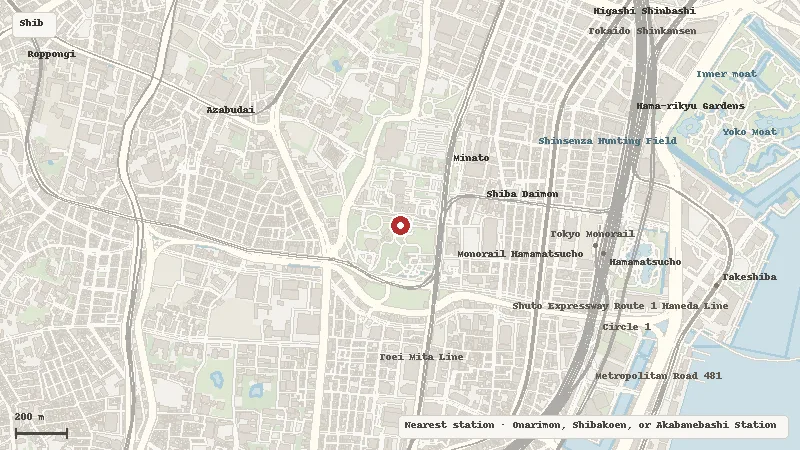
Map data © OpenStreetMap contributors