
Why go
Move slowly between the front and rear gardens to notice how the scale and use of background scenery change. The garden and museum are covered by the published admission arrangement, but maintenance closures still matter. Uneven and rounded steppingstones are part of the route; consult the garden directly about mobility needs rather than assuming a level path throughout.
Field Notes
Some of Isuien’s most revealing details are below your feet and above the eaves. The garden identifies reused stone mill mortars among its steppingstones, turning former working objects into elements of the path. It also explains that abalone shells placed on thatched roofs help deter crows from pulling out the thatch. These practical details show that the garden’s appearance depends on reuse and continuing care as well as an original design.
The buildings contain other traces of material history. Hyoshintei retains unusually thin handmade glass that subtly affects views into the garden, while the Yagyudo was rescued from a temple and brought here in the early twentieth century. Looking for these details adds a close-range layer to the broad borrowed scenery: paths, windows and roofs reveal choices that are easy to miss when concentrating only on the pond and distant hills.
Planning Notes
Suggested time on site: 45–90 minutes. Keep travel and waiting time separate from that estimate.
Timing noted for this stop: Daytime; verify current operating hours before travel.
Access reference: Kintetsu Nara Station. Check the final walking or connecting leg when choosing your route.
Location
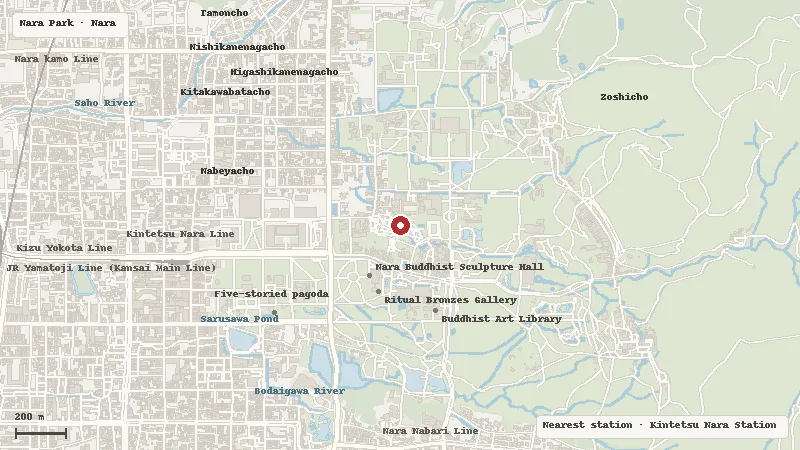
Map data © OpenStreetMap contributors