
Why go
The complex offers a close look at Islamic religious architecture and community life within Tokyo rather than presenting faith as a museum subject. Its prayer hall and cultural center make the building both an architectural landmark and a functioning institution.
Field Notes
Tokyo Camii and the Diyanet Turkish Culture Center occupy a quiet part of Yoyogi-Uehara, but the institution grew from a much older Muslim community in Tokyo. After the Russian Revolution, Kazan Tatar migrants moved through East Asia and some settled in Japan. In Tokyo they organized religious and educational activities, establishing an Islamic school before building a mosque beside it in 1938. That first mosque became an important gathering place for Muslims in the capital for several decades.
By the 1980s, the first mosque had deteriorated enough that it was taken down in 1986. The site was later transferred to the Republic of Turkey on the condition that a new mosque be constructed. A foundation connected with Turkey’s Presidency of Religious Affairs organized the project, architect Muharrem Hilmi Şenalp designed the replacement, and construction began in 1998. Craftspeople and engineers came from Turkey to work on the building and its decoration, and the present Tokyo Camii opened in June 2000.
The architecture draws heavily on classical Ottoman forms. The large central dome, half-domes, pointed arches, minaret, calligraphy, tile, carved details and stained glass create a visual language very different from the surrounding residential streets. Those elements are not simply display pieces: the upper hall is an active prayer space. The adjoining culture center supports lectures, exhibitions, classes and other activities, giving the institution a role throughout the week beyond congregational worship.
Non-Muslim visitors are generally welcomed, but the building should be approached as a functioning mosque rather than a museum where every area is permanently open. Modest dress, quiet behavior and respect for prayer are part of the visit. Friday congregational prayer changes general visitor access, while guided public tours are offered at designated times. Yoyogi-Uehara Station is the practical rail reference. A thoughtful visit therefore combines architecture with community history: the present building is a turn-of-the-century reconstruction, but the institution continues a Muslim presence in Tokyo that began with prewar migrant communities decades earlier.
General admission is free, and the institution publishes specific visitor guidance for non-Muslims, including Friday access after congregational prayer and scheduled Japanese-language tours on weekends and public holidays. Those arrangements reinforce that hospitality is structured around worship rather than replacing it.
Planning Notes
Suggested time on site: 45–120 minutes. Keep travel and waiting time separate from that estimate.
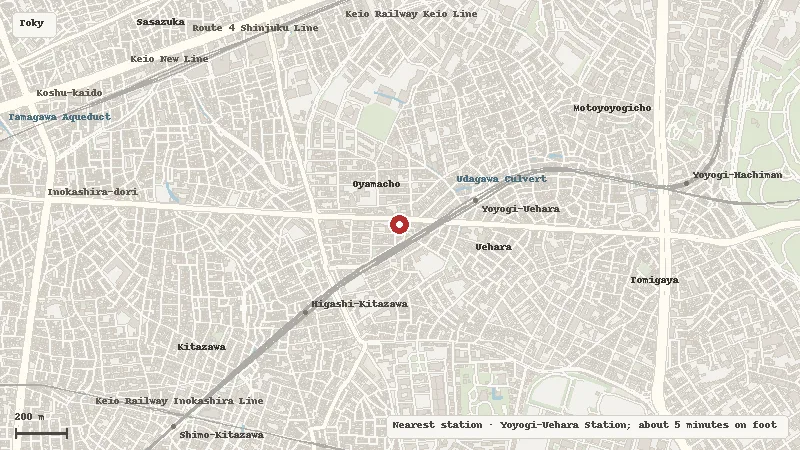
Access reference: Yoyogi-Uehara Station; about 5 minutes on foot. Check the final walking or connecting leg when choosing your route.
The public Japanese-language tour starts at 14:30 on Saturdays, Sundays and public holidays, with no reservation even for groups; no tour is held when a holiday falls on Friday. Its approximately 45–60 minutes describes the guided tour, not the entire cultural-center visit. Groups of five or more seeking a different time should use the official Visitors Calendar at least one week ahead; that form does not accept Monday or Tuesday bookings. Ordinary individual/small-group visiting remains unreserved, and Friday general visiting begins at 14:00. Check the calendar for available guided-tour appointments.
Location
Map data © OpenStreetMap contributors