
Why go
The estate makes Meiji-period elite domestic architecture easier to understand because Western and Japanese spaces survive side by side. The contrast between the mansion, Japanese rooms and garden is more informative than viewing either architectural tradition alone.
Field Notes
Kyu-Iwasaki-tei rewards visitors who treat the buildings and grounds as a single residential composition. The estate was created in 1896 for Iwasaki Hisaya, the third president of Mitsubishi and son of its founder, Yataro. More than twenty buildings once occupied the much larger property; the Western residence, billiards building and great hall of the Japanese residence survive. British architect Josiah Conder designed the Western house, a timber structure with two main floors and a basement. Its Jacobean decorative language gives the exterior and rooms a character quite different from the Japanese hall alongside it. Start by noticing how these neighboring architectural traditions occupy the same home, rather than expecting the whole estate to follow one style.
The contrast continues at a more intimate scale. The Western building was used for family gatherings and receiving foreign guests, while the Japanese residence followed shoin conventions and contained the family's living quarters. Only its large reception hall remains, so the surviving rooms represent a fragment of a far more extensive domestic arrangement. The separate billiards pavilion is another Conder design, resembling a Swiss mountain chalet rather than the main house. Its wooden walls, carved posts and broad projecting roof make a useful comparison with the formal facade nearby. An underground passage links it to the residence, an intriguing element of the original layout rather than a reason to assume a visitor route runs through it. Take time to compare materials and details between the buildings.
The grounds also carry a history that predates the Iwasaki family. They had been associated with the Echigo Takada domain's Edo residence, and later passed through Makino Sukeshige's ownership. After the Second World War, the property entered government use, including a period with the Supreme Court's Judicial Research and Training Institute. Preservation recognition came in stages: the Western residence and billiards building in 1961, the Japanese great hall and decorative elements in 1969, and the land and enclosing tiled walls in 1999. Tokyo assumed management in 2001, when the gardens opened to the public. These changes help explain why the visit feels both intimate and incomplete. It is a surviving portion of a private estate, subsequently used by public institutions and gradually protected as a whole historic setting. Leave time outside to understand the spaces between its architectural highlights.
Planning Notes
Suggested time on site: 60–90 minutes. Keep travel and waiting time separate from that estimate.
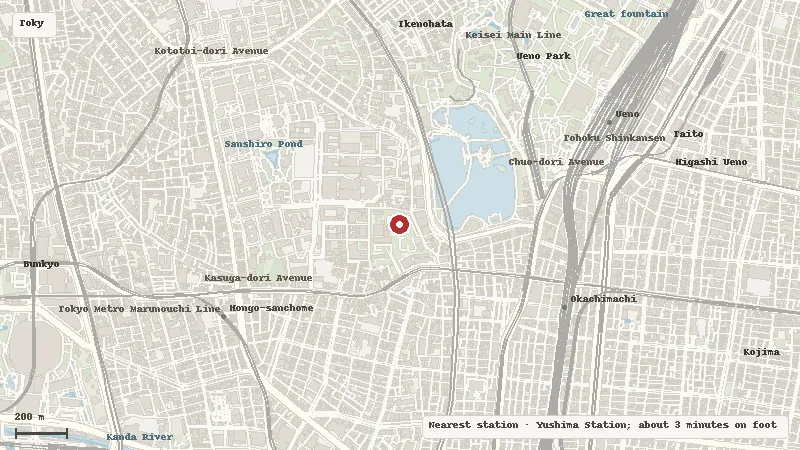
Access reference: Yushima Station; about 3 minutes on foot. Check the final walking or connecting leg when choosing your route.
Location
Map data © OpenStreetMap contributors