
Why go
The garden rewards attention to the cultural references built into its paths, viewpoints and small-scale landscapes.
Field Notes
At Engetsu-kyo, the Full Moon Bridge, look for the circle completed by the bridge’s reflection. The curved stone structure and its image in the water turn a small crossing into a composed scene. The garden authority attributes its design to the Ming scholar Zhu Shunshui, known in Japanese as Shushunsui, and identifies it as an early-Edo survivor. The nearby Tokujin-do also belongs to the garden’s older fabric and reflects Mitsukuni’s admiration for Chinese historical writing.
The inner garden, or Naitei, had a different role from the larger pond landscape: it accompanied the Mito family’s shoin-style guesthouse and was once separated by a Chinese-style gate. Keeping those distinct uses in mind makes the walk more legible. What can first look like one continuous ornamental park was also an arrangement of reception spaces, literary references and carefully chosen views within a powerful family’s residence.
Planning Notes
Suggested time on site: 1–2 hours. Keep travel and waiting time separate from that estimate.
Timing noted for this stop: Opening hour or late afternoon; spring and autumn are busiest.
Access reference: Iidabashi Station; about 8 minutes on foot. Check the final walking or connecting leg when choosing your route.
Location
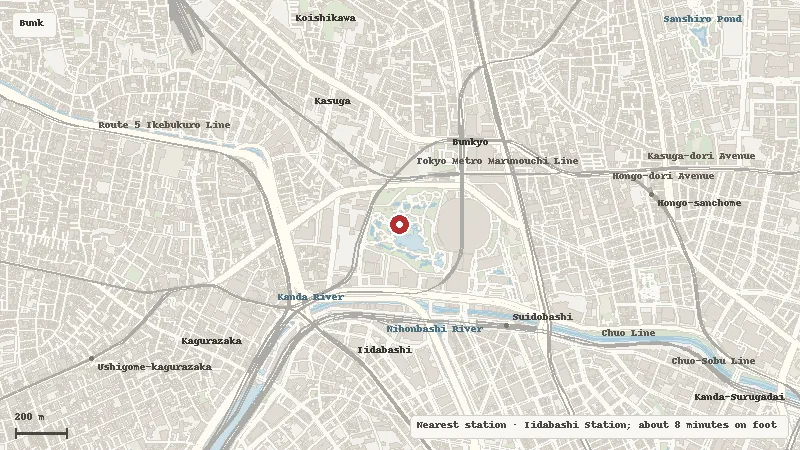
Map data © OpenStreetMap contributors