
Why go
The park is a useful way to experience Edo Castle as a larger defensive landscape rather than only the better-known palace-side remains. Surviving gates anchor the history, while open lawns and paths make the former bailey easy to cross at a slower pace.
Field Notes
Kitanomaru Park occupies the former northern enclosure of Edo Castle, but the wooded public landscape seen today is largely a postwar transformation. During the Tokugawa period, the area contained residences associated with branches of the shogunal family, including the Tayasu and Shimizu houses. Deep moats and fortified gates defined the northern approach to the castle complex. Tayasu Gate and Shimizu Gate preserve parts of that defensive geography within the modern park.
The Meiji government changed the area’s function again. The former castle ground became a base for the Imperial Guard, and numerous military buildings occupied the site. After the Second World War, planners chose to remove many of those structures and create green space around the Imperial Palace. New lawns, a pond and planted woodland were introduced, and the area opened to the public in 1969 as part of Kokyogaien National Garden.
Because of that history, the park’s apparently natural woodland should not be read as untouched remnant forest. Deciduous trees, flowering species and bird-attracting plantings were deliberately added to older evergreen growth. Museums and cultural institutions—including the National Museum of Modern Art, the National Archives, the Science Museum and Nippon Budokan—now occupy or border the former enclosure, giving the area a civic and cultural role very different from both the shogunal and military eras.
Shimizu Gate is particularly useful for understanding the castle layer. Visitors pass through a sequence of gate spaces and then encounter broad, uneven stone steps that retain an Edo-period defensive character rather than the proportions of a modern park staircase. Tayasu Gate similarly frames the approach between surviving moats. These structures make the original fortification legible even though most of the interior landscape has been remade.
Kitanomaru is therefore best visited as a layered urban landscape: Tokugawa castle enclosure, Meiji military ground and postwar public park occupy the same geography. The park itself does not need a single opening schedule, but museums, halls and parking operate independently. Kudanshita Station is a convenient approach, and a slower walk through the gates and moats reveals more history than treating the area only as green space beside the Imperial Palace.
Planning Notes
Suggested time on site: 60–150 minutes. Keep travel and waiting time separate from that estimate.
Access reference: Kudanshita Station; about 5 minutes on foot. Check the final walking or connecting leg when choosing your route.
Location
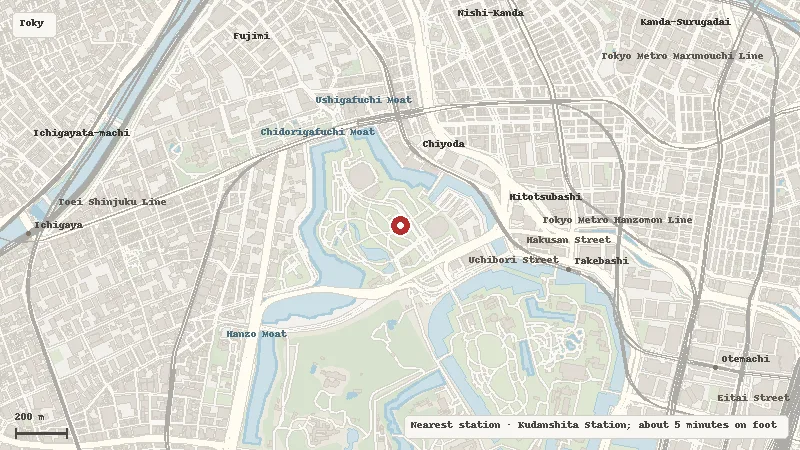
Map data © OpenStreetMap contributors