
Why go
The market offers a direct look at ingredients and small food businesses rather than a polished food hall. Its compact scale makes it easy to browse without committing half a day, while the mix of fresh goods and ready-to-eat items keeps the visit practical.
Field Notes
Yanagibashi Rengo Market developed from a modest form of food retail into a cooperative cluster of shops. The market's own history begins with Akira Abe selling fish brought from Ohama on a handcart. Other traders gathered nearby, creating several neighbouring markets that later combined under the Yanagibashi name. Business recovered after wartime decline, and the present cooperative was established in August 1992. This gradual formation explains the character of the place: it is a collection of specialist businesses with shared roots, rather than one shop arranged to present a single version of local cuisine.
Its identity as Hakata's kitchen comes from serving professional buyers and ordinary households as well as visitors. Seafood remains central to the city's description of the market, and the energy of buying and selling is part of the attraction. Approach it as a working food-shopping area in Haruyoshi, giving customers and traders room to conduct their business. The shops do not all follow one timetable, so a market opening time should not be taken as a promise that a particular counter or dining spot will be ready. Decide whether you are browsing ingredients, shopping or seeking a meal before choosing when to come.
The official directory gives a fuller picture than the label 'fish market' alone. Fishmongers appear alongside businesses selling tea, vegetables, pickles, meat and fish cakes, as well as dining places and coffee. A useful way to explore is to compare the ingredients with the prepared foods: look at what is sold for home cooking and what can be bought already made. That approach turns a short walk into an introduction to everyday food culture. If purchasing anything for later, ask the individual seller about storage and transport rather than treating all market products as equally easy to carry.
One specific local-food stop is Dontaku Mentai Nakaya, whose market listing centres on its homemade spicy mentaiko and also identifies salted and dried products. The shop describes sustained work on its seasoning and the challenge of maintaining its product as good-quality roe becomes harder to obtain. That small account adds a maker's perspective to the display counter. Looking for one such specialist story can be more rewarding than trying to sample everything. Check the shop's own hours and closed days, and let what is available on the day guide purchases instead of building the visit around an assumed tasting or fixed selection.
Planning Notes
Suggested time on site: 90–180 minutes. Keep travel and waiting time separate from that estimate.
Access reference: Watanabe-dori Station; about 3 minutes on foot. Check the final walking or connecting leg when choosing your route.
Location
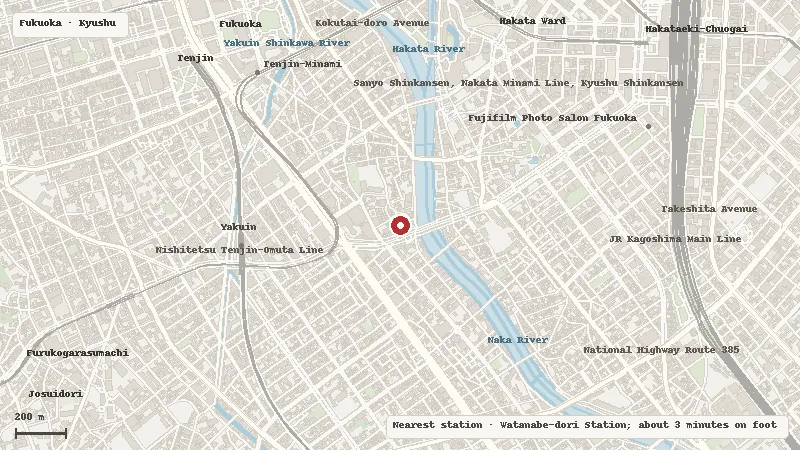
Map data © OpenStreetMap contributors