
Why go
The approach creates much of the experience: the bridge's open gaps force visitors to pay attention before stepping onto the small island. That brief crossing separates the ornate hall from the waterfront around it and gives the compact site a strong sense of transition.
Field Notes
Godaido stands on a small islet in Matsushima Bay and is one of the most recognizable structures associated with Zuiganji, yet it should be understood as a distinct temple subsite rather than as a substitute for the full Zuiganji complex. The present hall was completed in 1604 under Date Masamune, making it one of the earliest surviving buildings from his broad program of religious patronage around Matsushima. Its placement over the water gives the small structure a visual importance much greater than its physical size.
The religious site is older than the surviving building. Zuiganji’s own account connects the islet with an earlier hall dedicated to Bishamonten and later with Ennin, who is said to have installed images of the Five Great Wisdom Kings. Masamune’s rebuilding renewed that dedication in early-Edo architecture rather than creating an entirely new cult. The present square hall has a pyramidal roof, projecting entrance canopy, veranda and carved details, including animals of the twelve-year zodiac beneath the eaves.
The hall takes its name from the five Wisdom Kings enshrined inside. Those images are normally concealed, with public openings occurring only at long intervals. That practice reinforces Godaido’s status as an active devotional site rather than a display room. Both the building and associated religious images are protected as Important Cultural Properties.
Visitors reach the islet over short red bridges with open gaps in portions of the decking. Local interpretation often treats the need to watch one’s footing as a prompt for concentration before approaching the hall. Whatever symbolic meaning a visitor takes from the crossing, the bridges create a strong transition from Matsushima’s busy waterfront to a compact sacred enclosure.
Godaido is therefore most informative when read in relation to both Zuiganji and the bay. It preserves Date-period architecture, continues an older religious dedication and occupies a deliberately isolated setting where water is part of the experience. The stop can be short, but it should not be flattened into a photo opportunity or merged conceptually with the entire Zuiganji precinct. The hall’s 1604 completion also helps place it within Masamune’s larger Matsushima patronage immediately before the major rebuilding of Zuiganji itself.
Planning Notes
Suggested time on site: 45–90 minutes. Keep travel and waiting time separate from that estimate.
Access reference: JR Matsushima-Kaigan Station, about 7–10 minutes on foot. Check the final walking or connecting leg when choosing your route.
Miyagi Tourism Federation lists ordinary Godaido visits as 08:00 until sunset, with no regular closing day. Arrive well before dusk and confirm the current opening time before an early visit. The inner images are shown only at rare special openings.
Location
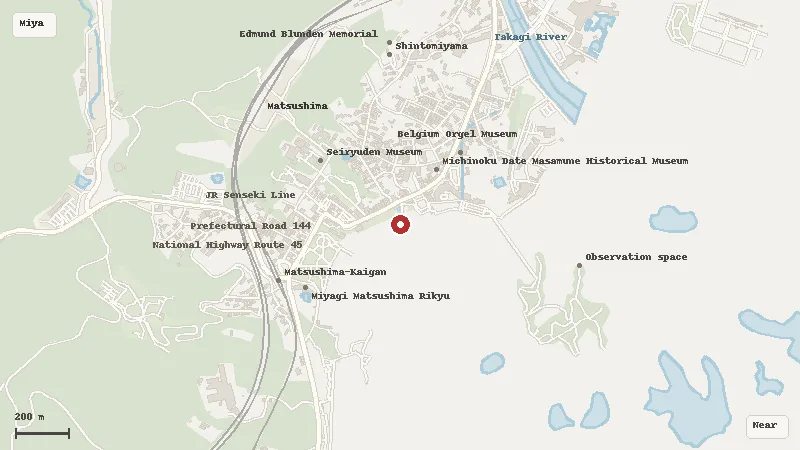
Map data © OpenStreetMap contributors