
Why go
The temple is a strong place to read architecture as political memory: the Maeda family used a carefully ordered Zen complex to commemorate Toshinaga. Its Sanmon, Buddha Hall and Lecture Hall give the visit a coherent architectural focus rather than a collection of unrelated buildings.
Field Notes
Zuiryuji Temple in Takaoka was created as a memorial institution for Maeda Toshinaga, the second head of the powerful Maeda family. Construction under his successor Toshitsune transformed the site into a major Sōtō Zen complex during the seventeenth century. Its scale and disciplined layout communicate both religious purpose and the resources of the ruling family, making the temple inseparable from the political history of early Takaoka.
The precinct follows a strong central axis through gates, courtyards and halls. Three buildings—the Sanmon gate, Butsuden and Hatto—were designated National Treasures in 1997, while several others hold Important Cultural Property status. The Butsuden is notable for massive timber construction and a lead-tiled roof; the Hatto preserves elaborate interior decoration connected with the temple’s memorial function. The complex therefore rewards attention to structure and spatial sequence rather than only to individual decorative objects.
Zuiryuji also helps explain the origin of Takaoka as a Maeda castle town. Toshinaga established Takaoka in 1609, and after his death the temple became part of the family’s memorial geography. His mausoleum is a separate site, so the temple should not be described as simply his tomb. Instead, it was the religious institution sponsored by the ruling house to conduct memorial rites and express dynastic authority through Zen architecture.
Later conservation preserved the core plan even though some original structures disappeared. Twentieth-century repairs maintained the surviving ensemble without turning the temple into a wholesale reconstruction. Visitors can therefore distinguish original national-treasure buildings, restored elements and the broader historical plan. Shin-Takaoka Station is within walking distance, making the site practical for a rail-based visit. Opening hours shorten in midwinter, so the current temple schedule should be checked before a late-day arrival. Zuiryuji’s strongest appeal is the connection between religious ritual, Maeda patronage and a remarkably ordered architectural complex that still conveys how political memory was built into the urban landscape of Takaoka.
The Butsuden’s heavy timber frame and lead-tiled roof, together with the measured sequence of gates and courtyards, make construction technique part of the experience. Visitors can read political patronage through proportion and material even without entering every interior space.
Planning Notes
Suggested time on site: 45–90 minutes. Keep travel and waiting time separate from that estimate.
Access reference: Shin-Takaoka Station, about 15 minutes on foot. Check the final walking or connecting leg when choosing your route.
Optional Sunday zazen is published for 05:15–06:10 in the Zendo, without advance application; confirm directly before attending because sessions can be cancelled. This activity does not make the ordinary sightseeing precinct open from 05:15.
Location
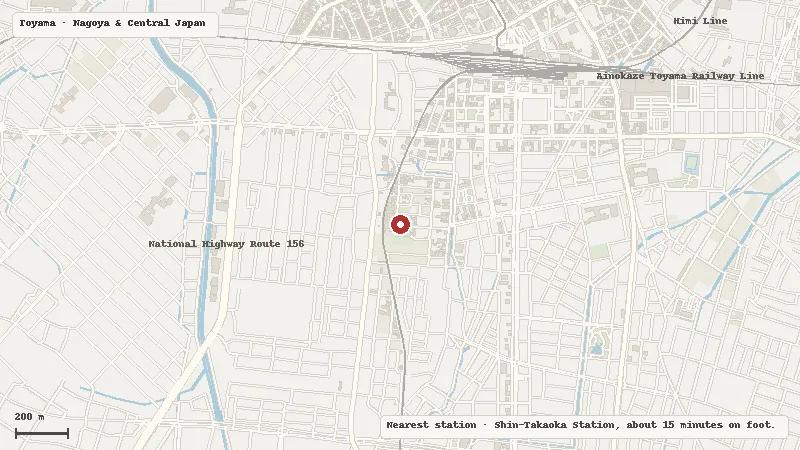
Map data © OpenStreetMap contributors