
Why go
The garden and nearby museum offer complementary ways to explore the cultural world of the Owari Tokugawa family.
Field Notes
The black entrance gate is a useful place to separate the site’s different ages. Kuromon was built in 1899 for the Owari Tokugawa residence. Its heavy timbers and restrained decoration convey the character of a grand household entrance, while roof tiles carry the family’s hollyhock crest. Nearby walls, the long building beside the gate and a well also preserve the setting of that later residence.
The present pond garden is much newer. Most of the grounds were destroyed in the 1945 air raids, after which the site served as a general public park; the Japanese garden was renewed in 2004. Its composition uses existing terrain and woodland, with water descending from a waterfall through a gorge towards a pond imagined as the sea. This is a contemporary re-creation of daimyo-garden principles on historically connected land. Looking at the old gateway before the newer landscape avoids reading every feature as an unchanged survival from the seventeenth century.
Planning Notes
Suggested time on site: 1–1.5 hours. Keep travel and waiting time separate from that estimate.
Timing noted for this stop: Morning; autumn foliage.
Access reference: Ozone Station; about 10–15 minutes on foot. Check the final walking or connecting leg when choosing your route.
The October 2026 operator calendar confirms closures on October 5, 13, 19 and 26; October 12 is open. Garden hours are 09:30–17:30, with final admission at 17:00. Garden admission is free on October 18, 2026. Events may change operating hours; use the dated calendar for later visits.
Location
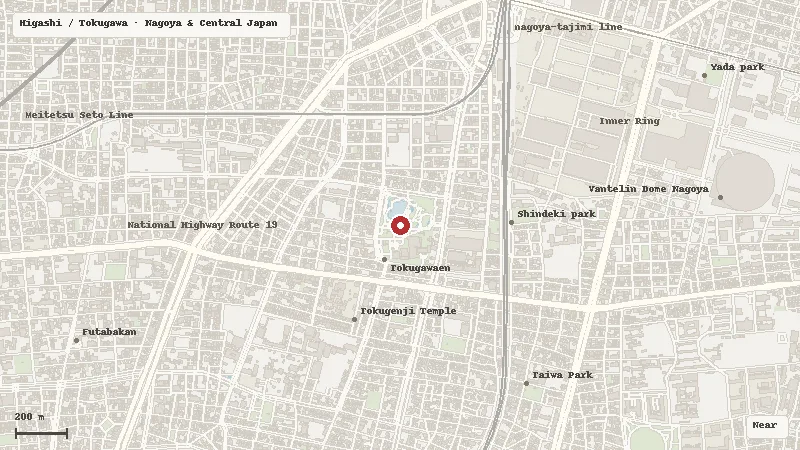
Map data © OpenStreetMap contributors