
Why go
The reconstruction is notable because it aimed for traditional wooden castle construction rather than a concrete shell. Combined with the hilltop setting and older castle grounds, it offers a clearer architectural reading than a keep visited in isolation.
Field Notes
Kakegawa Castle developed in the contested Tōkaidō corridor of late-medieval Shizuoka, where regional powers competed for control of routes linking eastern and central Japan. An earlier stronghold existed in the area before the castle was shifted and expanded on the present hill as Imagawa influence grew. After the Imagawa decline following the Battle of Okehazama, control changed during the wars of unification before Tokugawa Ieyasu held the region and was later transferred to the Kantō in 1590.
Yamauchi Kazutoyo became lord of Kakegawa in that same year and undertook a major rebuilding. Stonework, baileys and the first substantial keep are associated with his period. His later career in Tosa made the Yamauchi family prominent in historical narratives, but Kakegawa’s strongest surviving evidence is closer to ground level: the Ninomaru Goten palace, an Edo-period structure used for administration, residence and formal ceremonies. It is one of the small number of original castle palaces still standing in Japan.
The keep did not survive continuously. The 1854 Ansei Tōkai earthquake badly damaged it, and it was not rebuilt before the end of the shogunate. Other structures disappeared or were repurposed after the Meiji Restoration. In 1994, Kakegawa completed a wooden reconstruction of the tenshu using historical research and traditional building methods. The castle presents this as Japan’s first postwar reconstruction of a keep in wood.
That means the modern site contains different levels of authenticity that should be read separately. The palace is an original Edo-period building; the tower is a carefully researched twentieth-century reconstruction; stonework, earthworks and the hill preserve older spatial relationships. The value of the visit lies in comparing those layers rather than assuming every visible structure is equally old. From the hill, the connection among castle, town and the Tōkaidō corridor becomes easier to understand. Current opening hours and admission apply to the managed complex, and a visit should allow enough time for both the reconstructed keep and the surviving palace rather than treating the site as a single tower climb.
Kakegawa Station is close enough for the castle to work well as a rail-based stop, which reinforces the historical relationship between the fortified town and the major east-west travel corridor.
Planning Notes
Suggested time on site: 75–120 minutes. Keep travel and waiting time separate from that estimate.
Access reference: About 7 minutes on foot from JR Kakegawa Station. Check the final walking or connecting leg when choosing your route.
Location
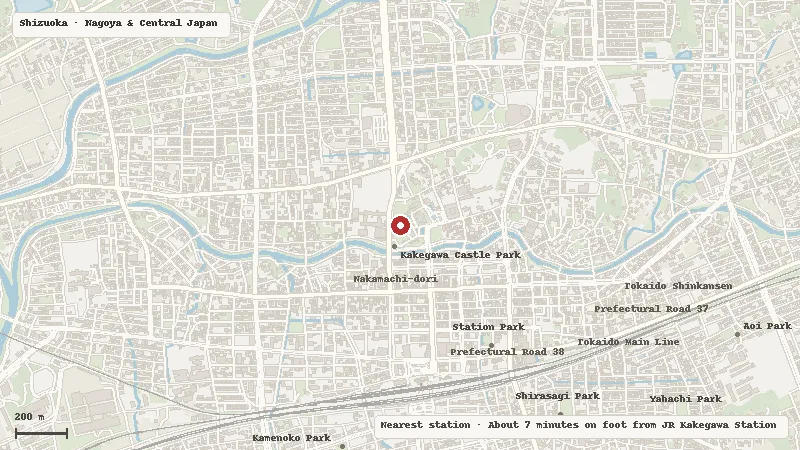
Map data © OpenStreetMap contributors