
Why go
Choose Goryu for a full mountain day rather than a short scenic stop. Its Escal Plaza base, connection with Hakuba47 and location at the southern end of the valley make it useful for skiers who want varied terrain while keeping one principal base area.
Field Notes
Hakuba Goryu developed gradually from a small lift operation into one of the major ski areas of the Hakuba Valley. The resort company was established in 1970, with an early lift opening that winter. A gondola followed in the 1970s, extending access to upper slopes and creating the basic mountain structure that later expansions would build on. Subsequent decades added restaurants, night-skiing capacity, snowmaking and the Escal Plaza base center.
The resort’s modern identity also depends on its connection with neighboring Hakuba47. A joint ticket relationship began in the 1990s, allowing skiers to move through a linked mountain system. That connection is convenient, but it can also create confusion when course counts or operating information are quoted without distinguishing Goryu itself from the combined Goryu–Hakuba47 area. For accurate planning, the live mountain status should be read by specific zone and lift.
Goryu’s terrain spans clearly different difficulty levels. Panorama provides a gentler upper-mountain route, while Grand Prix and technical areas offer steeper or ungroomed skiing. Lower runs around Toomi and Iimori serve different visitor groups, and night skiing uses a separate operating pattern. Snowmaking infrastructure supports lower areas, but opening and closing dates remain dependent on snow and weather rather than on a fixed annual promise.
Escal Plaza gathers rentals, ticketing, changing rooms, shops, food and other visitor services at the base. A bath facility there is separate from lift operation, and upper-mountain facilities such as Alps 360 provide another service point. Non-skiers may use some of these areas under different ticket or gondola conditions from skiers.
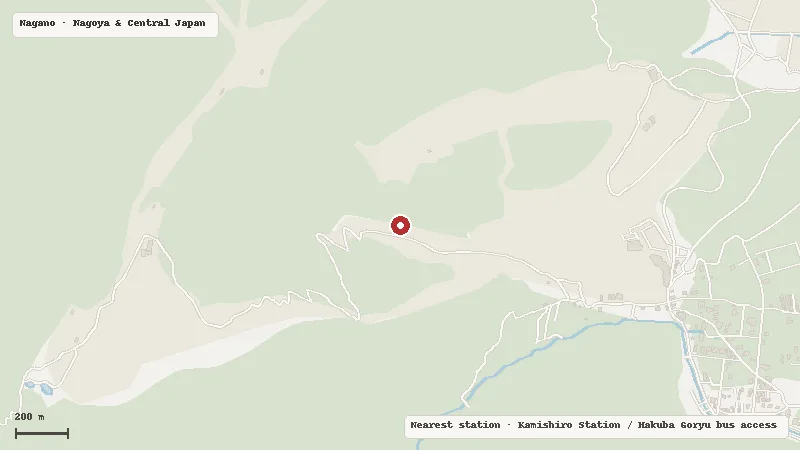
For a practical visit, Kamishiro Station and Hakuba Goryu bus access provide the main transport references. Current 2026–27 ticket products may be on sale before the operator fixes every lift’s daily schedule, so purchase availability should not be mistaken for proof that the full mountain is open. Goryu is best understood as an evolving resort whose history is visible in successive infrastructure layers, with modern operations tied closely to live snow, lift and connection status.
Goryu’s development timeline also shows repeated adaptation: snowmaking expanded in the 1990s, snowboarding became fully permitted by 1999, and upper-mountain summer uses later broadened the resort beyond winter skiing. Those changes explain why today’s complex cannot be reduced to its original lift network.
Planning Notes
Suggested time on site: 4–8 hours. Keep travel and waiting time separate from that estimate.
Access reference: Kamishiro Station / Hakuba Goryu bus access. Check the final walking or connecting leg when choosing your route.
Hours/access: On October 1, 2026 the operator announced November 21, 2026 as the opening date for skiing in the Toomi No.1 Lift area, supported by a new ice-snow system. This is an opening-area announcement, not confirmation that the full mountain, every lift or every facility opens that day. Operating hours and facility details are to be announced closer to opening; check the live snow, weather and lift report before travel.
The official 2026–27 lift-ticket page separates ordinary Goryu/Hakuba47 daytime passes from night-ski passes. Escal Plaza’s building access and ticket validity times are not resort-wide lift hours; the ticket center’s opening times are still listed as to be determined.
The booking link is the operator-endorsed daytime lift-ticket purchase portal for Goryu/Hakuba47. The downstream official shopping system could not be retrieved during this check, so this records the entry route only and does not claim current product inventory or a working checkout.
Location
Map data © OpenStreetMap contributors