
Why go
This is best understood as historical entertainment rather than a preserved Edo town. The recreated setting, demonstrations and performances make it useful for travelers who want a theatrical introduction to period imagery and crafts alongside Hokkaido sightseeing.
Field Notes
Noboribetsu Date Jidaimura opened in 1992 as a purpose-built historical theme park near Noboribetsu’s hot-spring district. Its streets, gates, shops and performance spaces are modern reconstructions designed to evoke selected images of the Edo period. The site should therefore be approached as interpretation and entertainment rather than as a preserved castle town or relocated historic settlement.
The park uses scale and movement to create immersion. Visitors walk through timber-fronted streets and enter performance spaces rather than viewing history only through objects in cases. Scheduled shows feature ninja action, oiran-themed presentation and other theatrical forms inspired by popular culture of early-modern Japan. Those performances draw on recognizable historical genres and imagery but are modern productions, not documentary reenactments of ordinary seventeenth-century life.
Workshops, displays and reconstructed interiors provide quieter context between shows. Depending on the current program, visitors may encounter crafts, weapons-related interpretation, merchant or domestic settings and costume experiences. The result sits somewhere between film set, open-air museum and live theater, with the balance intentionally weighted toward family entertainment. That mix is part of the site’s value because it shows how modern tourism chooses to represent the Edo period.
The use of the Date name also connects the attraction with northern historical memory, but the park freely combines material from wider Edo popular culture. It should not be read as a literal reconstruction of one Date-domain town. The selective emphasis on ninja, samurai, merchant streets and stage entertainment reveals what late-twentieth-century audiences expected an “Edo town” to contain.
Operating hours change by season, and the show timetable is essential if live performances are a priority. Noboribetsu Station is the main rail reference, followed by bus access. A successful visit therefore depends on choosing whether the goal is theatrical entertainment, reconstructed streets or broader historical interpretation. The park is most informative when its modern staging is acknowledged openly: it does not preserve an original neighborhood, but it provides a clear example of how Japanese popular history has been packaged for tourism since the 1990s.
The park uses a longer summer day and shorter winter schedule, with admission ending before closing. Travelers focused on shows should compare the current performance timetable with those seasonal hours rather than assuming attractions run continuously throughout the day.
Planning Notes
Suggested time on site: 60–120 minutes. Keep travel and waiting time separate from that estimate.
Access reference: JR Noboribetsu Station; bus about 8 minutes. Check the final walking or connecting leg when choosing your route.
Winter operation from November 1, 2026 through March 19, 2027 closes at 16:00, with last admission at 15:00. From November 4, the first ninja show is at 09:40 and the first winter-only samurai show at 10:20; later sessions are listed in the current programme. The operator announces a whole-park maintenance closure March 8–11, 2027. Show times are separate from park hours.
Location
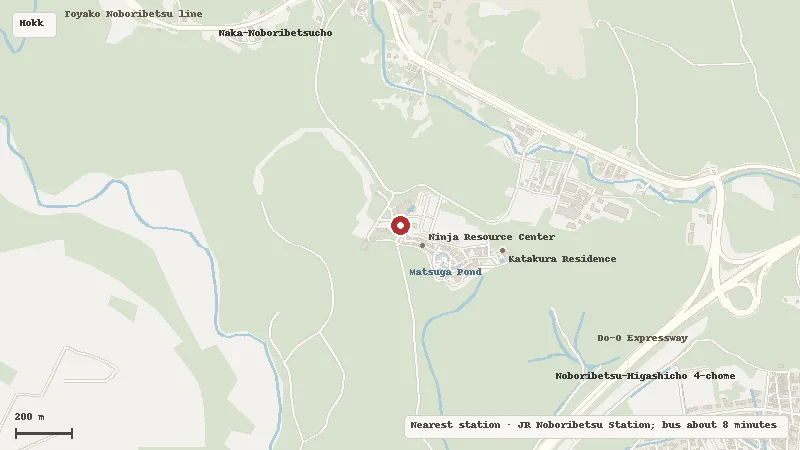
Map data © OpenStreetMap contributors