
Why go
The attraction works as a piece of film history and as a deliberately preserved mid-century streetscape. Its coastal setting on Shodoshima adds context to the school and village imagery, making the visit more than a collection of indoor memorabilia.
Field Notes
Twenty-Four Eyes Movie Village on Shodoshima preserves a film landscape connected with Sakae Tsuboi’s novel Twenty-Four Eyes, a work deeply associated with the island. The present visitor site grew from the open set constructed for the 1987 screen adaptation directed by Yoshitaka Asama and starring Yuko Tanaka. Rather than dismantling the set after production, the location was retained and developed as a village-like attraction with school buildings, houses, lanes and waterfront scenery evoking an earlier Showa-period community.
That origin must be distinguished from another important Twenty-Four Eyes site on Shodoshima: the actual former branch school used in the celebrated 1954 film adaptation. The real school building dates to the early twentieth century and remained in educational use until 1971. By contrast, the Movie Village is a reconstructed cinematic environment created decades later for the 1987 production. Treating the two sites as interchangeable erases the most important distinction between preserved historic fabric and film-set reconstruction.
The Movie Village deliberately mixes set preservation with museum functions. Displays interpret Tsuboi, Japanese cinema and the screen history of the novel, while classrooms are furnished to evoke the period represented in the story. The waterfront and village arrangement let visitors move through a three-dimensional version of a fictional and cinematic world rather than only seeing props in cases.
The site therefore has layered cultural value even though many buildings are not old in the usual architectural sense. Tsuboi’s writing, the 1954 film, the original branch school and the later 1987 set all contribute to Shodoshima’s public memory of the story. The Movie Village itself has now existed for decades as a tourism and interpretation site, creating its own history around those adaptations.
For visitors, the useful approach is to read the village as a preserved film set and museum landscape, not as an untouched prewar settlement. Island transport and ferry conditions should also be checked independently from the attraction’s own hours. A visit becomes more meaningful when the reconstructed set is compared mentally—or physically on a wider island itinerary—with the genuine former school building that inspired and supported earlier filming.
The attraction normally operates through daytime hours, but ferry and island weather conditions can affect whether visitors reach the site as planned.
Planning Notes
Suggested time on site: 90–150 minutes. Keep travel and waiting time separate from that estimate.
Access reference: Tonosho Port; island bus to Tanoura Eigamura. Check the final walking or connecting leg when choosing your route.
The optional direct ferry between Olive Navi pier and the Movie Village has a published 2026 season of March 14–November 30 and a 09:30–16:30 service window. Wednesdays and Thursdays are normally non-operating days, with busy-period exceptions; the calendar and weather can change operation. Each crossing takes about 10 minutes. This is a transport schedule, not a museum opening interval, and no sailing after November 30 is implied.
Location
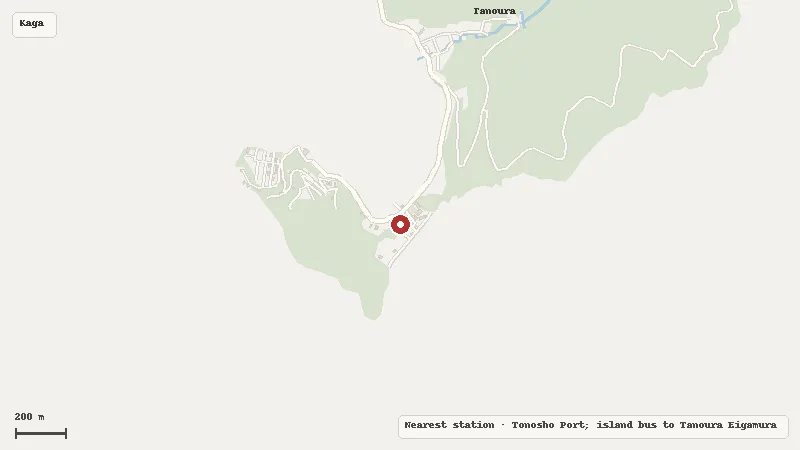
Map data © OpenStreetMap contributors