
Why go
The maritime setting is the defining feature: this was a castle designed in direct relationship with the harbor rather than an inland hill fortress. Even without the original keep, seawater moats and surviving grounds make that coastal defensive logic visible.
Field Notes
Takamatsu Castle, preserved today as Tamamo Park, was built at the end of the sixteenth century at the edge of the Seto Inland Sea. Ikoma Chikamasa established the castle after receiving control of Sanuki under Toyotomi Hideyoshi. Unlike an inland fortress simply located near the coast, Takamatsu was designed so seawater entered its moats directly. That maritime arrangement supported both defense and transport and is the key to understanding why the site is often described as one of Japan’s notable water castles.
The Matsudaira family later ruled the Takamatsu domain and expanded the castle during the Edo period. Surviving structures from that era include the Tsukimi Yagura turret and Mizunote Gate, along with stone walls and sections of the inner and middle moats. Modern land reclamation changed the shoreline around the site, but saltwater still reaches the moat system, and sea fish remain a visible reminder that the castle was physically tied to the Inland Sea.
The main keep no longer survives. Archaeological work and repairs have clarified the former base, and the raised keep platform now functions as a viewpoint over the park, central Takamatsu and the port. Another major structure is Hiunkaku, built in 1917 for descendants of the Matsudaira family as a guest house and residence. Its rooms and garden belong to a later historical layer than the surviving feudal fortifications, making the park a record of continued use rather than a frozen castle from one date.
Tamamo Park therefore rewards visitors who distinguish original, reconstructed and later elements. Walking routes reveal moats, gates, turrets, stonework and the relationship with the port, while boat experiences on the moat emphasize the water-based design from another angle. This is not a modern replica centered on a rebuilt tower; its strongest feature is the surviving connection among fortification, seawater and urban port. Opening hours and admission vary seasonally, and special access to structures or boat services can use separate schedules, so the current park information should be checked before planning around one specific component.
The park sits close to central Takamatsu and the port, making the castle easy to combine with ferry or rail travel while still preserving its original maritime context.
Planning Notes
Suggested time on site: 60–120 minutes. Keep travel and waiting time separate from that estimate.
Access reference: Kotoden Takamatsu-Chikko Station; about 2 minutes on foot (JR Takamatsu about 5 minutes). Check the final walking or connecting leg when choosing your route.
The city schedules its Trim sports/recreation festival in and around Tamamo Park on October 12, 2026, from 10:00 to 15:00, subject to weather cancellation. Associated events outside the main programme have 09:00–09:30 reception, and the moat SUP advance places are already full. Use public transport because park parking is limited. Event times do not replace seasonal West/East Gate hours.
Location
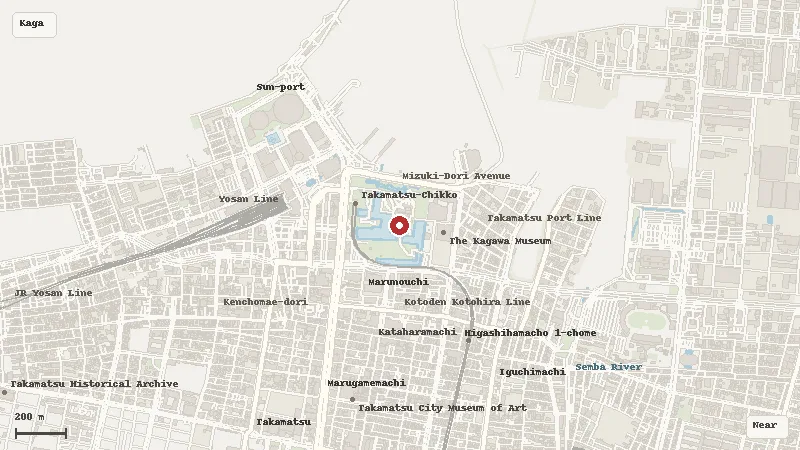
Map data © OpenStreetMap contributors