
Why go
The museum gives archaeological evidence and historical context to a landscape often encountered first through myth and shrine tradition. It is especially valuable before or after Izumo Taisha because the galleries connect material finds with the wider cultural story of ancient Shimane.
Field Notes
Beside Izumo Taisha, the Shimane Museum of Ancient Izumo gives a shrine visit a much wider regional setting. Its collections connect religious traditions with ancient daily life, metalworking and the formation of communities across Shimane. One productive way to approach the galleries is to keep three kinds of evidence in mind: excavated objects, written accounts and later reconstructions. The museum's models of an exceptionally tall earlier shrine illustrate scholarly attempts to imagine its form; they are interpretations rather than surviving buildings. The Izumo no kuni fudoki, an eighth-century regional gazetteer, offers another route into the ancient landscape, bringing descriptions of local life into conversation with the material objects in the galleries.
The huge uzubashira timbers provide a striking place to begin that comparison. Excavations in the shrine precinct in 2000 and 2001 uncovered pillar groups made from three large cedar trunks, together measuring about three meters across. The museum explains how groundwater helped preserve the buried wood. Stone-packed postholes and the arrangement of the pillars gave researchers evidence to compare with an old building diagram held by the shrine's hereditary priestly family. Scientific analysis and documentary research point strongly toward the sanctuary constructed in 1248. Looking at the timber before studying the models makes the distinction between what was found and what has been reconstructed especially clear, and gives architectural scale a physical reference.
The bronze gallery changes the question from building scale to social power. Objects from Kojindani and Kamo-Iwakura anchor an account of Yayoi-period ritual and the ways communities came together. A reconstruction of buried bronzes helps visitors think about the circumstances of discovery, rather than viewing every sword or bell simply as a beautiful isolated object. The gallery then moves to ornamented swords of the Kofun period, explaining how the possessions of powerful leaders could become symbols for the groups around them. Comparing ritual bronzes with these later status objects is a useful way to follow changing forms of authority through the displays.
Folklore & legends
Izumo's myths belong to a separate but connected strand of the visit. The museum presents Susanoo's defeat of Yamata-no-Orochi alongside traditions recorded in the regional Fudoki, and considers their retelling through kagura and other performance. Read these as inherited stories and cultural practices, with their own history of interpretation, rather than as archaeological descriptions of events.
Planning Notes
Suggested time on site: Allow 90–150 minutes for the permanent galleries. Keep travel and waiting time separate from that estimate.
Access reference: Ichibata Railway Izumotaisha-mae Station, about 7 minutes on foot; local buses serving Izumo Taisha stop at Seimon-mae, about 2 minutes on foot. Check the final walking or connecting leg when choosing your route.
The renewal special exhibition runs October 9–November 29, 2026. Curator talks take place Sundays October 11, 18, 25 and November 1, 8, 15, 22, 29, from 14:00 to 15:00, with 20 places and advance sign-up by phone, fax or the museum-linked electronic service; an exhibition ticket or museum pass is also required. The booking URL is the operator-linked web advance ticket for the special/permanent exhibition set, not a mandatory reservation for ordinary permanent-gallery entry. Check the ticket site for sales conditions and current availability. The special gallery opens at 10:00 on October 9 only, while museum-wide opening stays 09:00.
Location
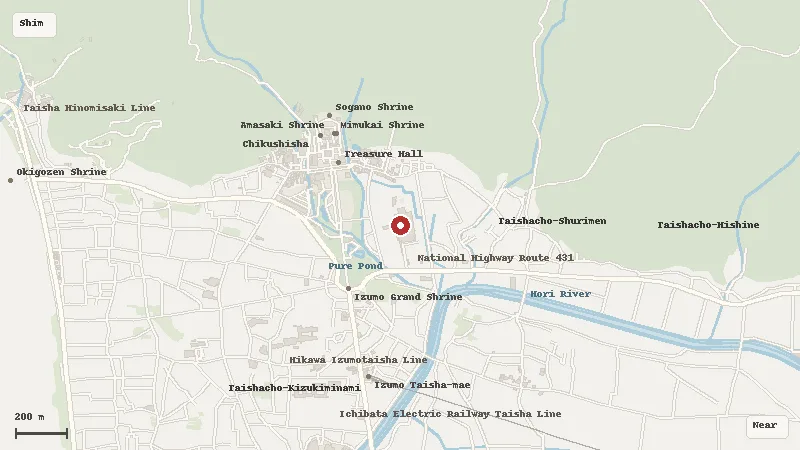
Map data © OpenStreetMap contributors