
Why go
The garden connects botanical display with the work of one of Japan's best-known plant researchers, so the visit has both landscape and scientific context. Its Mount Godai setting also makes it a different experience from a compact urban conservatory or museum.
Field Notes
Kochi Prefectural Makino Botanical Garden opened on Mount Godaisan in 1958, one year after the death of Kochi-born botanist Tomitaro Makino. The institution was conceived as more than a memorial museum. By placing Makino’s biography alongside living plants, herbarium material and an active research program, the garden connects his scientific career with the field observation and specimen work on which plant taxonomy depends.
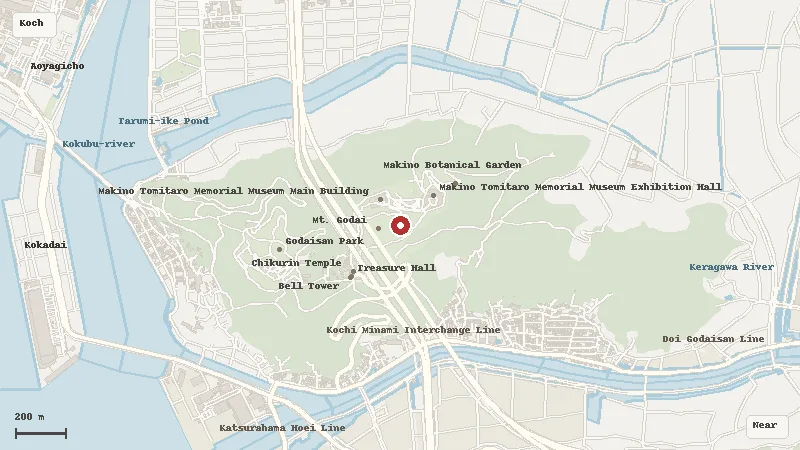
The grounds now cover roughly eight hectares and contain more than 3,000 species of wild and cultivated plants. The terrain of Mount Godaisan gives the collection a varied setting rather than a flat display garden. Parts of the southern area also retain traces of earlier cultural landscape connected with nearby Chikurin-ji, including old routes and stonework. That means the garden was inserted into an already meaningful mountain environment rather than created on an empty suburban site.
Makino’s career forms the interpretive center. He moved to Tokyo as a young man, worked with the University of Tokyo’s botany department and published plant names in the late nineteenth century. Over his lifetime he assigned scientific names to more than 1,500 plants, assembled hundreds of thousands of specimens and built a substantial botanical library. His detailed drawings and later illustrated flora helped make identification accessible well beyond a small academic circle.
The garden expanded significantly in 1999, strengthening its public-education and research roles. Current work includes surveys, conservation of wild plants in Kochi, international research, herbarium management and preservation of Makino’s documentary legacy. Walking from exhibits about his life into the living collection makes the method behind taxonomy easier to understand: observation, collecting, comparison, drawing and publication are parts of one process.
For visitors, the garden provides several route lengths rather than one mandatory circuit. Opening hours, maintenance closures and special-event admission can change by date, so the current official calendar should be used when planning a long visit. The site is best understood as both biography and botany: a memorial institution created in 1958 that continues active scientific and conservation work instead of freezing Makino’s achievements in the past.
Adult admission and special-event pricing can change with major exhibitions, and the official garden calendar also lists maintenance closures. Those date-specific details should be checked before committing to a long circuit through the grounds.
Planning Notes
Suggested time on site: 1–2 hours for short or first-time routes, or about 4 hours for the longer family circuit. Keep travel and waiting time separate from that estimate.
Access reference: JR Kochi Station → MY Yu Bus to Makino Botanical Garden main gate. Check the final walking or connecting leg when choosing your route.
The booking link is for an optional paid garden guide for groups of 10 or more; apply from 12 months to 2 weeks before the visit and await confirmation. Ordinary admission tickets, including advance tickets, are sold at the garden’s main-building or middle-gate counters. Group-guide durations do not replace the recommended time for visiting the whole garden.
Location
Map data © OpenStreetMap contributors