
Why go
The mountain approach is part of the castle's identity, not just an inconvenience on the way to the keep. Climbing through the defensive terrain makes the site's strategic position clear, while the surviving original tenshu gives the visit unusual architectural weight.
Field Notes
The climb above Takahashi leads to a small surviving keep with an unusually large landscape behind its story. Bitchu Matsuyama began in 1240 with a fort on Omatsuyama, one of Mount Gagyu's several peaks; the familiar keep stands on Komatsuyama at about 430 metres. This distinction helps explain why the mountain's history extends beyond the buildings at the end of the visitor route. Successive fortifications once occupied a much wider area, while the surviving keep belongs to the castle's later, early-modern form.
Mizunoya Katsumune's rebuilding campaign of 1681–1683 gave the castle its principal surviving structures. The keep, double turret and surviving historic mud-wall section make this an important stop for anyone interested in original Japanese castle fabric. Preservation is also a local story: historical surveys by teacher Shinano Tomoharu helped inspire a conservation movement, and repairs in 1939 involved residents and students carrying roofing materials uphill. Looking at the roof after making the ascent gives that undertaking a more tangible scale than its date alone suggests.
Allow attention for the enclosures as well as the tower. The official building guide presents Sannomaru as the forward defensive area and Ninomaru as a final defensive position, making the route a useful introduction to the castle's layered arrangement. Within Honmaru, some gates, single-storey turrets and stretches of wall were restored in 1997. Reading the signs with that distinction in mind reveals a combination of surviving architecture and carefully recovered layout. The interest lies in how these elements work together across the confined mountain site, rather than in the height of one dramatic building.
Plan the outing around the walking approach instead of counting only time inside the keep. The visitor guide allows roughly two hours with the return walk from Fuigo Pass, where the final ascent alone is described as about twenty minutes. Starting farther down the mountain creates a different outing, so confirm your arrival point before setting an onward departure. Transport arrangements and the last uphill service need checking separately from the castle's closing time. For a visit shared with Takahashi's other historic attractions, retain enough flexibility to descend without rushing and keep the mountain experience as a substantial part of the day.
Planning Notes
Suggested time on site: 120–180 minutes. Keep travel and waiting time separate from that estimate.
Access reference: JR Bitchu-Takahashi Station, then shared taxi/taxi or local transport to Fuigo Pass, followed by about a 20-minute climb. Check the final walking or connecting leg when choosing your route.
Access notice checked October 2, 2026: the lower pedestrian trail from above Takahashi High School to Fuigo Pass is closed all day on October 12–16, November 16–20 and November 23–27, 2026 for tree cutting. Walkers must follow the published detour; the castle main enclosure and keep remain accessible. This is a lower-trail restriction, not a castle closure.
Location
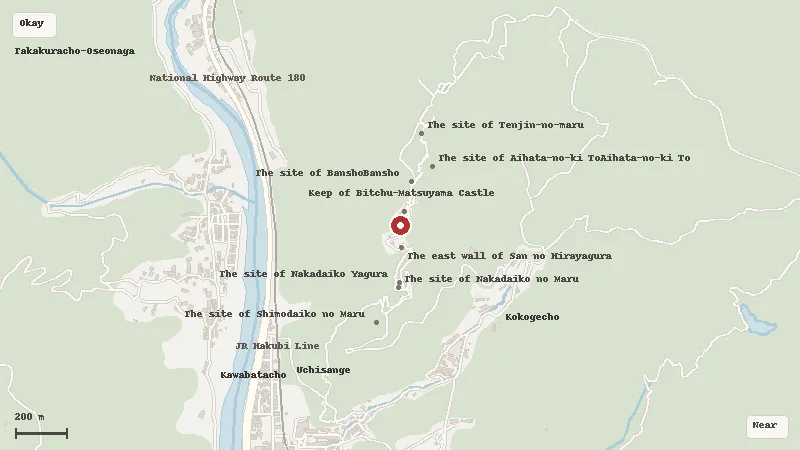
Map data © OpenStreetMap contributors