
Why go
The garden is a quieter counterpoint to central Osaka's dense urban sightseeing. Its scale allows visitors to move between formal seasonal displays and older tree-lined sections, making it useful for a slower walk rather than a quick photo stop.
Field Notes
Nagai Botanical Garden is a place to read Osaka's relationship with plants as well as to enjoy flowers. It opened on April 27, 1974, in the southeastern part of Nagai Park, with ornamental, educational and specimen gardens intended to encourage learning from nature. The city's Natural History Museum opened here at the same time, a partnership that helps explain the botanical garden's educational character. Its landscape has accumulated layers since then: the peony garden followed in 1976, hydrangea and dogwood areas in 1984, and a Japanese iris garden in 1995. Seeing those spaces as additions made over decades brings a different perspective to a walk that might otherwise be organized only around whichever flowers are in bloom.
The Historical Forest makes that longer perspective especially tangible. Six planted areas interpret geological and ecological stages from about 66 million years ago to the present, including glacial and interglacial environments, secondary woodland and evergreen broadleaf forest. The planting was developed with the Natural History Museum and uses living relatives able to grow in today's Osaka climate to evoke earlier vegetation. It is therefore an interpretive collection rather than an untouched prehistoric forest. Around the small pond, dawn redwood, sequoia and bald cypress invite comparison of markedly different tree forms. The display also recognizes botanist Shigeru Miki, who named the Metasequoia genus and studied ancient plant communities. Look at labels and groupings together: the arrangement tells a story that individual specimens alone cannot convey.
The garden's 2022 reopening represents another chapter in caring for this living collection. Its renewal account describes problems caused by clay-heavy soil, crowded trees and deteriorating water quality in the large pond as rainwater flowed into it. Work during a five-month closure beginning in November 2021 sought to improve growing conditions and prepare the garden for continued development. That background is worth remembering while exploring: a botanical garden is maintained through choices about roots, spacing and water, not simply by leaving plants alone. Let the historical plantings provide one anchor for a visit, then use the changing seasonal gardens to shape the rest of the walk. Returning in another season can reveal different parts of a collection that has been deliberately developing for more than half a century.
Planning Notes
Suggested time on site: 90–180 minutes. Keep travel and waiting time separate from that estimate.
Access reference: Nagai Station; short walk. Check the final walking or connecting leg when choosing your route.
The booking link is the official daytime garden electronic-ticket service. An electronic ticket is needed for the northeast gate and is also accepted at the main and information-center gates. It does not establish admission to the separately ticketed teamLab night attraction. Check the site for discount and free-admission eligibility procedures.
Location
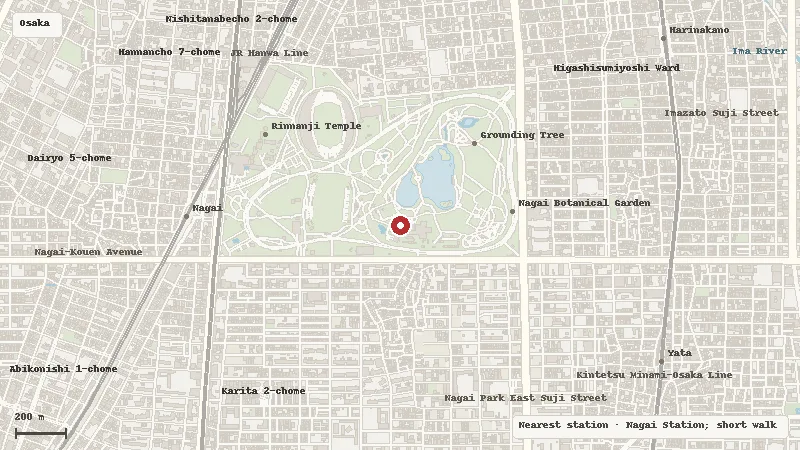
Map data © OpenStreetMap contributors