
Why go
The park rewards more than a simple green-space visit because the farmhouse museum adds a cross-regional architectural layer. Buildings relocated from around Japan can be compared in one landscape, while the surrounding park remains a separate, much broader recreational setting.
Field Notes
Hattori Ryokuchi is one of Osaka’s major green parks, but its present landscape is the result of many separate projects rather than one single design. Planning for the green space began before the Second World War, and the park opened in 1950. Over the decades it accumulated recreation areas, gardens, cultural facilities and sports infrastructure, creating a place where a visitor can spend an hour on lawns or most of a day moving between specialized sites.
One of the most important cultural additions is the Open-Air Museum of Old Japanese Farm Houses. Its collection began when a gassho-style house from Shirakawa was relocated in 1956 because a dam project threatened the original site. Other traditional buildings from different parts of Japan followed, including farmhouses and raised structures. The museum therefore is not an old village that naturally grew inside Hattori; it is a curated collection of relocated architecture that allows regional building traditions to be compared in one setting.
The surrounding park continued to change. A circular flower garden was established in 1959, a Japanese garden followed in the early 1960s, and later projects added pools, plazas and other public facilities. The western central plaza was prepared for the first National Urban Greening Fair in 1983. After the 1995 Hanshin-Awaji earthquake, improvements also strengthened the park’s disaster-response role. Pine groves, bamboo, open lawns and river-edge landscapes coexist with these constructed facilities.
That mixture is the reason to plan the visit by interest rather than by a single park opening time. The general grounds are broadly accessible, but museums, botanical areas, pools, riding facilities and sports venues have their own schedules and sometimes their own fees. Ryokuchi-koen Station is the main rail approach for many visitors. A short visit can focus on the general landscape; a longer one can pair it with the farmhouse museum or another managed facility. Check the current schedule for the specific component you want to enter instead of assuming that an open park gate means every attraction inside is operating.
The park’s size also means that walking time between major facilities can be meaningful, so a museum-focused visit and a general green-space visit should not be planned as if they use the same route or duration.
Planning Notes
Suggested time on site: 90–240 minutes. Keep travel and waiting time separate from that estimate.
Access reference: Ryokuchi-koen Station; about 5 minutes on foot. Check the final walking or connecting leg when choosing your route.
Location
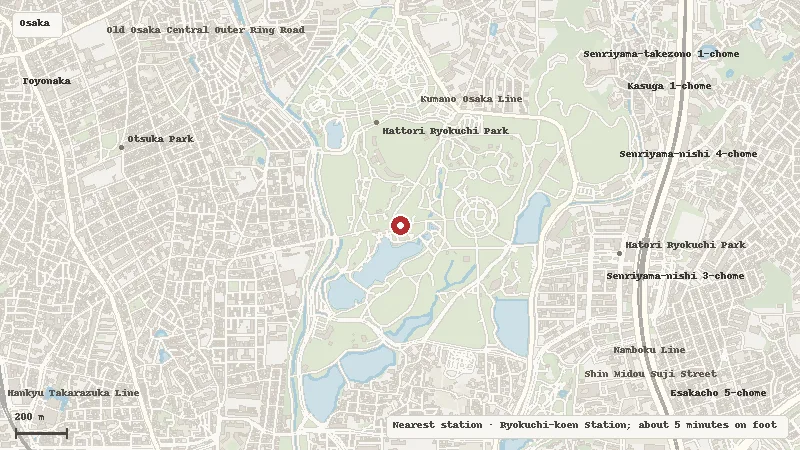
Map data © OpenStreetMap contributors