
Why go
The trees are not simply a scenic tunnel: their dense planting reflects how coastal homes were protected from wind and weather. Walking or cycling the narrow lanes lets the village structure and shade pattern emerge gradually instead of being reduced to one photo stop.
Field Notes
Bise-Fukugi Tree Road is not a single ornamental avenue but a network of lanes within a living coastal village in northern Okinawa. Dense fukugi trees form green walls around household plots, creating narrow corridors of shade between homes, gardens and the sea. The trees were planted primarily as infrastructure: their thick evergreen foliage and closely spaced trunks reduce the force of typhoon winds and salt-laden air before it reaches buildings and crops.
That function reflects the environmental realities of the Ryukyu Islands. Strong seasonal winds, typhoons and sea spray can damage lightweight structures and domestic gardens. In Bise, fukugi belts work together with walls, roof forms, lane orientation and compact house plots to shelter the settlement. Older trees show how long this system has been maintained. Similar planting patterns once appeared more widely in Okinawa, making Bise valuable as a surviving village-scale example rather than merely as a scenic tunnel of trees.
Walking through the village reveals variation that photographs of one lane cannot. Some passages are deeply enclosed by foliage, while others open toward houses, fields or the coastline. The same trees that reduce wind also create a noticeably cooler, shaded microclimate. Property boundaries are defined by vegetation without turning every edge into masonry, giving the settlement a distinctive rhythm of narrow corridors and sudden openings.
Because Bise remains inhabited, respectful access is essential. The public lanes are not permission to enter private gardens, yards or houses, and quiet behavior matters more here than at a purpose-built attraction. The walk can be combined with the shoreline or nearby Bisezaki, but cart services and other commercial experiences are separate operations with their own conditions. There is no need to assign a fabricated attraction-wide opening time to the public village lanes. Visit in daylight, follow current local guidance, keep to public routes and treat the landscape as working environmental design that residents still live within rather than as an open-air museum built for visitors.
The nearby coast and Bisezaki can extend the walk, but shoreline conditions and private property boundaries should be treated separately from the public village lanes. The setting works best when visitors move slowly enough to notice how trees, walls, houses and sea exposure relate to one another rather than treating the village as a single photo stop.
Planning Notes
Suggested time on site: 45–120 minutes. Keep travel and waiting time separate from that estimate.
Access reference: Bise-iriguchi bus stop; about 5 minutes on foot. Check the final walking or connecting leg when choosing your route.
Location
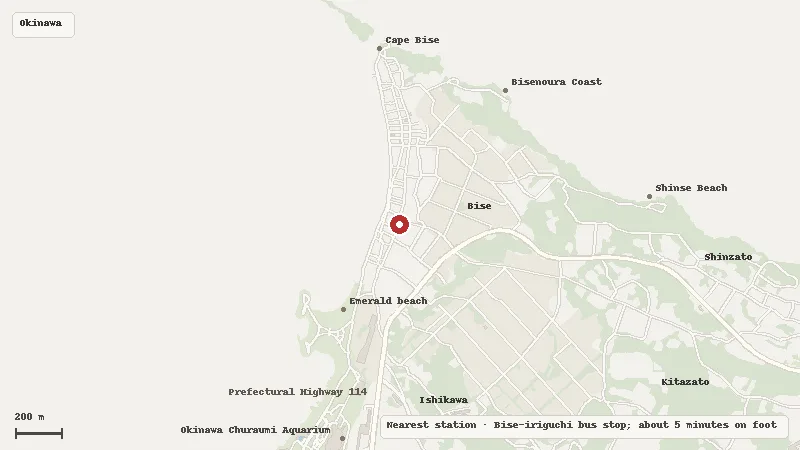
Map data © OpenStreetMap contributors