
Why go
The shrine's identity joins religious devotion with performance culture in a setting shaped by the sacred Omine mountains. Its Noh association and pilgrimage role give the visit more context than a scenic mountain shrine stop alone.
Field Notes
Tenkawa Daibenzaiten-sha stands in a mountain valley of Nara near the sacred Omine landscape, where ascetic religious practice has deep roots. The shrine’s own history places its origins in early Japanese religious tradition and connects the surrounding mountains with forms of practice later associated with Shugendo. Its location is therefore central to the visit: this is not an urban Benzaiten shrine moved into scenic surroundings, but a sanctuary whose identity developed within a wider culture of mountain pilgrimage and austerity.
Benzaiten is associated in Japan with water, music, eloquence and the arts, and those themes shape Tenkawa’s particular character. The shrine preserves masks, costumes and other objects connected with Noh and performance traditions. Artists and performers have long visited to pray or make offerings, reinforcing a relationship between religious devotion and artistic practice that distinguishes Tenkawa from nearby temple sites focused more directly on ascetic training or Buddhist pilgrimage.
Shrine tradition also associates Tenkawa with figures such as Emperor Tenmu, En no Gyoja and Kukai. These stories place the sanctuary within major narratives of court history, Buddhism and mountain religion, but they belong to sacred memory rather than to one simple documentary chronology. The documented survival of worship, ritual objects and performing-arts connections is historically important even where the earliest origin accounts cannot be verified in modern archival terms.
One of the shrine’s most recognizable ritual objects is the Isuzu, a linked set of bells whose distinctive form connects sound, movement and worship. That symbolism fits the shrine’s broader artistic identity and helps explain why musicians and performers have felt a particular affinity with the place.
Tenkawa remains an active sanctuary in a small mountain community. Bus service is limited compared with urban Nara, and mountain weather can affect travel, so a timed visit should be planned around the current shrine and transport schedules. The most useful approach is to separate three layers without flattening them: documented objects and institutional history, the religious network of Omine and Shugendo, and the myths through which the shrine explains its own sacred origins. Together those layers make Tenkawa one of the more distinctive Benzaiten sites in Japan.
Folklore & legends
Tenkawa’s sacred traditions connect the shrine with En no Gyoja, Emperor Tenmu and the Omine mountains. The shrine also explains its Isuzu bells through the myth of Ame-no-Uzume dancing before the heavenly rock cave, when sound and performance helped draw Amaterasu back into the world. These narratives are religious traditions rather than independently verifiable episodes in the shrine’s construction history. Their importance lies in the way they connect Benzaiten, music, ritual movement and mountain worship, giving the shrine’s performing-arts identity a mythic framework that remains meaningful in contemporary devotion.
Planning Notes
Suggested time on site: 45–90 minutes. Keep travel and waiting time separate from that estimate.
Access reference: Kintetsu Shimoichiguchi Station → bus to Tenkawa Daibenzaitensha. Check the final walking or connecting leg when choosing your route.
Location
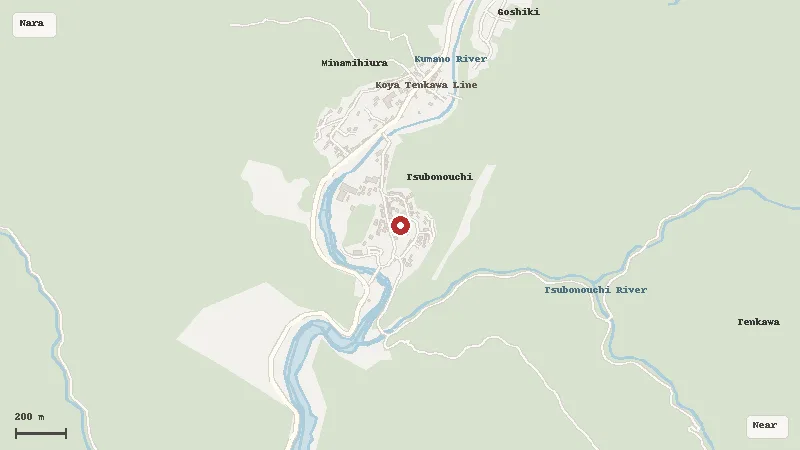
Map data © OpenStreetMap contributors