
Why go
Muro-ji rewards the climb because its architecture is encountered gradually through the wooded slope rather than in one open precinct. The sequence of stone steps, halls and pagoda gives the visit a strong sense of movement through the mountain setting.
Field Notes
Muro-ji is best experienced as an ascent through a wooded valley, with buildings revealed in stages rather than across one large courtyard. A small red bridge leads from the village approach toward the temple, and the route continues beside the river to the Niomon gate. Stone steps then climb among cedars toward the main group of halls. The five-story pagoda is striking for its intimate scale, standing only about sixteen meters high among much taller trees. In late spring, rhododendrons lend color to the paths; autumn foliage gives the same sequence a different setting. The approach and the pauses between buildings are therefore part of the visit, not merely the distance to cover before reaching a famous photograph.
Its familiar name Nyonin Koya, often rendered as Koyasan for Women, recalls its welcome to female worshippers when access to Koyasan was restricted. That reputation adds a social dimension to the mountain setting and its Buddhist art. The temple holds National Treasure sculptures, including an eleven-faced Kannon and a wooden Shaka Nyorai, so leave time for the interior collections as well as the outdoor architecture. The upper reaches require further walking, and the temple is reached from Muroguchi-Ono Station by an onward road journey. Plan the connection and the climb together instead of treating a short-looking station distance as the whole excursion. Taking a slower route through the woods allows the religious setting and sculpture to receive attention alongside the pagoda.
The temple's foundation account places its beginnings in the late Nara period, when monks prayed in this sacred mountain landscape for the recovery of Crown Prince Yamabe, the future Emperor Kanmu. It names the Kofuku-ji monk Shuen as a central figure in constructing the temple. Esoteric Buddhist practice subsequently became increasingly important here, with the Kamakura period bringing a hall for initiation rites and an upper sanctuary honoring Kobo Daishi. This layered development helps explain why the precinct contains buildings and devotional associations from different periods rather than one uniform architectural moment.
Folklore & legends
The same temple account describes a local belief that dragons inhabited mountain cavities and links that belief with the valley's clear water. Imperial envoys came to pray for rain from the early Heian period onward. These dragon traditions belong to the site's religious understanding of water and landscape; they offer context for the wooded valley without turning its natural features into literal evidence of a supernatural event.
Planning Notes
Suggested time on site: 45–90 minutes. Keep travel and waiting time separate from that estimate.
Access reference: Kintetsu Muroguchi-Ono Station → bus to Muroji-mae. Check the final walking or connecting leg when choosing your route.
The Japan Travel and Tourism Association's September 30, 2026 listing specifies evening light-up on November 7–8, 14–15, 21–23 and 28–29, 17:00–20:00 with last reception at 19:30. The evening visitor route extends only as far as the five-story pagoda. The listing warns that the pagoda and Golden Hall are currently obscured by roof-replacement work; confirm the condition before a visit focused on these buildings. The Nara tourism bureau places normal peak foliage in mid-November to early December. These limited-route evenings do not extend ordinary full-temple hours every day.
Location
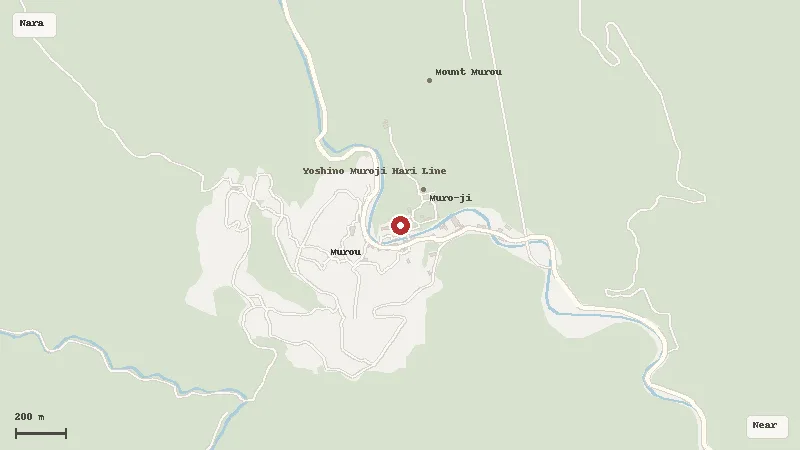
Map data © OpenStreetMap contributors