KyushuPreview
Nagasaki Confucian Shrine & Historical Museum of China
In Oura, A vividly colored Confucian shrine complex and museum built with direct Qing-era Chinese.

EXPLORE BY PLACE + LENS
Search the interactive Places catalog for landmarks, local neighborhoods and unexpected stops by destination, Lens or keyword. Read Public guides and browse Preview introductions. A free account lets you filter your saved Public Favorites.
Looking for an editorial shortlist? Start with Japan Essentials, then use Discover to combine interests and refine your search.
In Oura, A vividly colored Confucian shrine complex and museum built with direct Qing-era Chinese.
Tateyama / Suwa: A major museum of Nagasaki’s overseas-exchange history built around a reconstructed Nagasaki.
A stone-paved slope through the former foreign-settlement district of Higashiyamate.
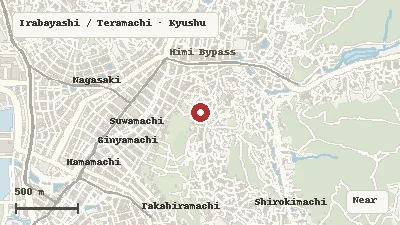
Nagasaki Kameyama Shachū Memorial Museum introduces the trading and maritime group associated with Sakamoto Ryoma in a restored house linked to its history. The domestic scale brings a period of political and commercial change into a tangible setting, with exhibits explaining the organization’s place in late-shogunate Nagasaki.
Find Nami at Moe no Sato on Kumamoto's ONE PIECE recovery trail.
Meet Chopper beside Kumamoto's zoo on the ONE PIECE recovery route.
The restored former Dutch trading post that served for roughly two centuries as Japan’s — Dejimamachi / Nagasaki Waterfront.
Find Franky beside Takamori Station on the Kumamoto recovery trail.
Pair the Nico Robin statue with Kumamoto's KIOKU earthquake-memory site.
See Zoro in Ozu Central Park on Kumamoto's Straw Hat statue route.
Meet Usopp directly outside JR Aso Station on the Kumamoto statue trail.
See Sanji in Mashiki and the food-linked story behind his placement.
Slow down beside the pond and tea rooms at Fukuoka's Yusentei Park.
In Fureai Hiroba / Mifune, the Brook bronze statue in Mifune’s Fureai Hiroba, close to the town’s dinosaur museum.
A large Tenjin amusement center with crane, purikura, driving, shooting, rhythm, video, card.
In Sumiyoshi Kaigan Park / Uto, the large Jinbe bronze statue at Sumiyoshi Kaigan Park in Uto.
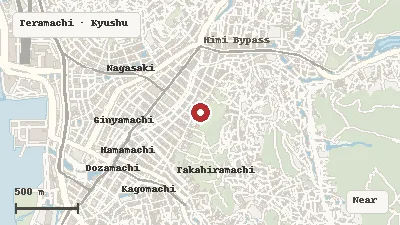
Kōfuku-ji brings Nagasaki’s Chinese community and Ōbaku Zen history into the temple streets of Teramachi. Its Chinese-influenced architecture and connection with the monk Ingen make it a place to consider how religious practice travelled through the port and became part of the city’s cultural landscape.
A rare cluster of seven late-nineteenth-century wooden Western-style residences packed; a stop in Higashiyamate.
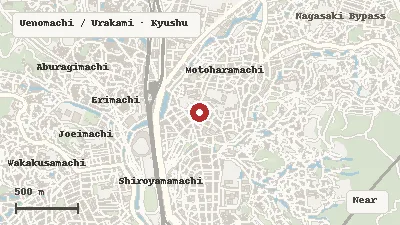
Nyokodō preserves the tiny hut where physician and atomic-bomb survivor Takashi Nagai spent his final years writing. Its two-tatami scale brings his postwar life into close focus, connecting a modest personal space with the themes of faith, neighbourly love and peace that shaped his work.
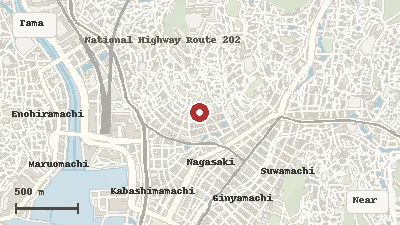
Shōfuku-ji is an Ōbaku Zen temple in Nagasaki whose historic buildings and reused roof-tile wall reward close attention. The combination of religious architecture and carefully assembled tile surfaces gives the grounds a distinctive character within the city’s Chinese-influenced temple heritage.
Thanks for helping us improve. We have received your feedback.