
Why we recommend it
Use the airport guide to connect the flight terminal to the correct rail station or shuttle path, especially when Terminal 3 or a terminal change is involved.
Special Visit Instructions
Some places are easy to walk into. These are not. Follow the ticket, arrival, entry and venue-specific steps below before relying on this stop in a fixed itinerary.
Confirm your terminal
Terminal 1 and Terminals 2/3 use different airport rail stations. Confirm the airline terminal before choosing the train destination.
Use the terminal-specific station
Terminal 1 is served by Narita Airport Station. Terminals 2 and 3 are served by Narita Airport Terminal 2·3 Station; Terminal 3 requires the longer walk from that station.
Use the free shuttle or the T2–T3 corridor
Free shuttle buses connect the terminals. Terminals 2 and 3 can also be connected on foot through the access corridor.
Check shower and nap-room location before security
Narita lists landside showers in Terminal 1 and airside shower/nap facilities in Terminals 1 and 2. Eligibility depends on the facility and security zone.
Match the Yamato counter to your Narita terminal and wing
Yamato lists Terminal 1 North and South Wing pickup on 4F with shipping on 1F, Terminal 2 pickup on 3F with shipping on 1F, and Terminal 3 pickup and shipping on 1F. For Terminal 1, confirm the airline wing before sending luggage to the airport.
About this place
Narita opened on May 20, 1978 under the name New Tokyo International Airport, with Runway A and Passenger Terminal 1 entering service together. Its role as Tokyo’s principal international gateway developed alongside dedicated ground transport and additional terminal capacity. JR and Keisei rail service reached the station beneath Terminal 1 in March 1991, and Passenger Terminal 2 opened in December 1992. The Narita Sky Access Line began operating in July 2010, adding another rail path between the airport and the Tokyo region. Terminal 3 opened in April 2015, creating the present three-terminal passenger arrangement.
The terminal layout directly affects how a traveler should approach the airport. Terminal 1 is served by Narita Airport Station, while Terminals 2 and 3 use Narita Airport Terminal 2·3 Station. Narita’s official rail guidance describes Terminal 1 as about a five-minute walk from its station, Terminal 2 as about a five-minute walk from the Terminal 2·3 station, and Terminal 3 as about a ten-minute walk from that same station. That difference is small on a map but material when luggage, check-in deadlines or a tight connection are involved.
Free terminal shuttle buses provide the main landside connection among all three terminals. The airport currently lists roughly ten minutes between Terminals 1 and 2 on the direct shuttle and also provides all-terminal routes, while Terminals 2 and 3 can be connected on foot through an access corridor. Passengers transferring after security may have different shuttle arrangements, so the public landside bus should not be assumed to be the only option in every connection scenario. A practical itinerary should therefore keep the flight terminal, rail station and transfer status together as one planning decision.
Narita also provides facilities specifically useful after a long flight or during a long connection. The airport lists landside shower facilities in Terminal 1 as well as airside shower and nap-room facilities in Terminals 1 and 2. Some facilities are restricted to passengers who have completed departure procedures or are in transit, so their location relative to immigration and security matters. Travelers should check the current service page before planning around a shower or nap room, especially when an itinerary requires changing terminals.
For ground transport, JR, Keisei and Narita Sky Access services make rail the central structured connection to Tokyo, but the correct station name still depends on the terminal. The useful rule is simple: verify the airline terminal before choosing the train, and add extra walking or shuttle time when Terminal 3 or a terminal change is involved. This terminal-first approach is more reliable than treating the airport’s NRT code as a single arrival point. It also gives travelers a clearer basis for deciding whether a tight rail connection, hotel transfer or same-day onward journey has enough margin.
Planning notes
Check the airline terminal before buying a rail ticket or choosing a station. Terminal 1 uses Narita Airport Station; Terminals 2 and 3 use Narita Airport Terminal 2·3 Station, with Terminal 3 requiring the longer walk. Free shuttle buses connect all terminals, and Terminals 2 and 3 can also be connected on foot through the access corridor. Narita lists shower and nap-room facilities in Terminals 1 and 2, so long-haul travelers should check location and landside/airside eligibility before relying on them. Leave a distinct terminal-transfer buffer rather than treating NRT as a single building.
Yamato lists Terminal 1 North and South Wing pickup on 4F with shipping on 1F, Terminal 2 pickup on 3F with shipping on 1F, and Terminal 3 pickup and shipping on 1F. For Terminal 1, confirm the airline wing before sending luggage to the airport.
For a layover outing, reserve the Transit & Stay program before travel and follow the confirmed meeting instructions. The airport lists landside counters in T1 Central Building 1F and T2 Main Building 1F. Decide your return cutoff from the onward flight and terminal, not just the advertised tour duration.
Location
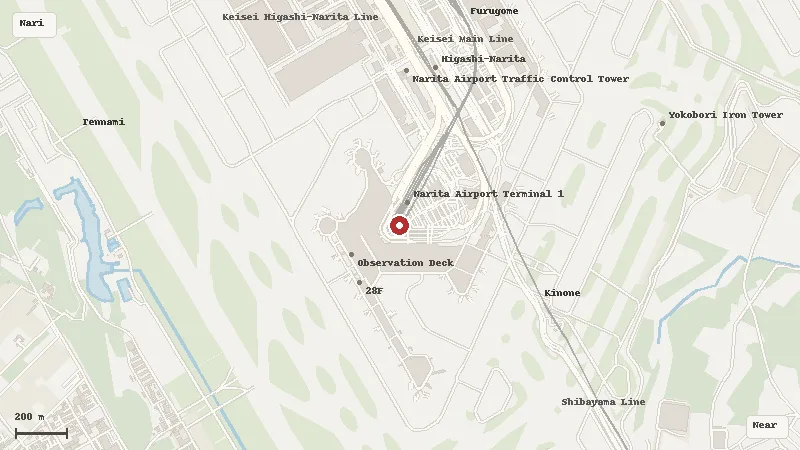
Map data © OpenStreetMap contributors