
Why we recommend it
Plan Haneda as part of the itinerary: verify the operating terminal, choose the city rail connection, and allow margin when a journey crosses terminals.
Special Visit Instructions
Some places are easy to walk into. These are not. Follow the ticket, arrival, entry and venue-specific steps below before relying on this stop in a fixed itinerary.
Confirm the operating terminal
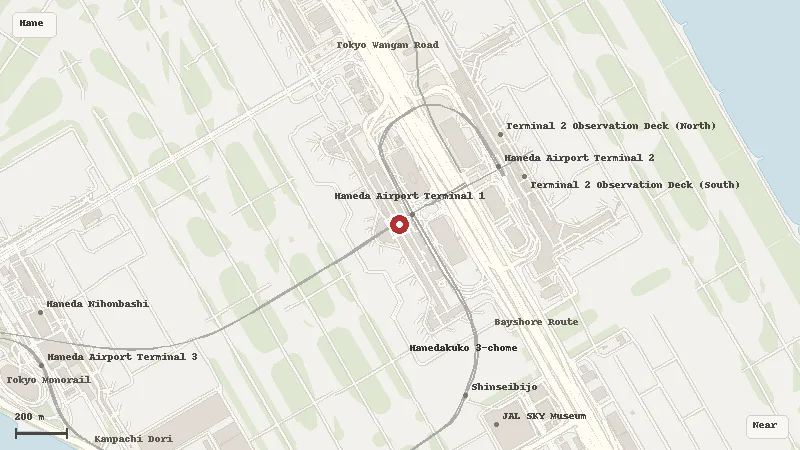
Check the airline and Haneda terminal before setting a meeting point or rail destination; the airport operates three passenger terminals.
Use the rail stop for your terminal
Keikyu and Tokyo Monorail serve Haneda directly. Terminals 1 and 2 use B1F rail access; Terminal 3 has rail gates at the arrival/departure levels.
Use the airport’s transfer options
Free shuttle buses connect the terminals. Eligible domestic/international connecting passengers can also obtain free Keikyu or Tokyo Monorail transfer tickets for Terminal 3 connections.
Match facilities to the terminal
Terminal 3 has 24-hour showers and temporary baggage storage; Terminal 2 also has showers, while Terminal 1 does not have a dedicated shower room. Check current hours before crossing terminals for a facility.
Check the Yamato counter for your Haneda terminal
Yamato baggage service is terminal-specific at Haneda. Terminal 1 Domestic and Terminal 2 Domestic use 1F for pickup and shipping; Terminal 2 International uses 3F for pickup and 2F for shipping. Terminal 3 currently uses 2F for both pickup and shipping; Yamato states that the Terminal 3 pickup counter moves to 1F from November 30, 2026.
About this place
Haneda’s present passenger-terminal story begins in the postwar period, when the airport was returned to Japan in 1952 and the government chose a private-capital model for the new terminal because public finances were constrained. Japan Airport Terminal Co. was established in 1953, and the passenger terminal opened in May 1955. The Tokyo Monorail opened between Hamamatsucho and Haneda in September 1964, giving the airport a direct urban rail connection before the later airport-rail network took its current form. When Narita opened in May 1978, most international airline operations moved there, leaving Haneda primarily focused on domestic traffic for the following period.
Haneda expanded again as demand grew: Terminal 2 opened in December 2004, and a new international passenger terminal opened in October 2010. Work between 2017 and 2020 expanded and renovated Terminal 2 for international passenger use, helping produce the current three-terminal arrangement. For a traveler, that history matters because “Haneda Airport” is not one interchangeable building; the first practical task is to confirm whether the flight uses Terminal 1, Terminal 2 or Terminal 3. Each terminal has its own access points and service mix, while the airport provides several ways to move between them.
Keikyu and Tokyo Monorail both serve Haneda directly. At Terminals 1 and 2, the rail platforms are on B1F, while Terminal 3 has rail gates integrated with its arrival and departure levels. Airport-operated free shuttle buses connect the terminals, and eligible passengers transferring between domestic and international flights can obtain free transfer tickets for Keikyu or Tokyo Monorail between Terminal 3 and Terminals 1 or 2. Because the transfer method depends on the terminal pair and connection type, a tight itinerary should be built around the actual terminal assignment rather than the airport code alone.
Haneda also has practical facilities that can change how an arrival or layover is handled. The airport currently lists shower rooms in Terminal 2 and Terminal 3, with Terminal 3’s shower facility operating around the clock, while Terminal 1 has no dedicated shower room. Temporary baggage storage is available in all three terminals, and Terminal 3 includes 24-hour storage counters. These services make it possible to clean up or leave luggage before entering Tokyo, but their terminal-specific locations and hours should be checked before walking between buildings solely for an amenity.
For arrival planning, the airport’s location inside Ōta City makes rail access a central part of the guide rather than an afterthought. A traveler arriving late should still verify the final Keikyu or monorail departure, because a terminal or facility that remains open does not imply that every transport service runs overnight. For departures, the same principle works in reverse: confirm the terminal, allow security and airline processing time, and add a separate buffer if the route requires an inter-terminal transfer. Treating Haneda as a multi-terminal transport hub is the most reliable way to avoid preventable transfer mistakes.
Planning notes
Start with the airline terminal assignment, then match the rail station or terminal transfer to that building. Keikyu and Tokyo Monorail serve the airport directly; airport-operated free shuttle buses connect the terminals. Travelers making eligible domestic/international connections can obtain free transfer tickets for Keikyu or Tokyo Monorail between Terminal 3 and Terminals 1 or 2. Terminal 3 has 24-hour shower and temporary-baggage facilities, while services in the domestic terminals follow their own hours. Late at night, check the current transport timetable rather than assuming that 24-hour terminal access means trains continue all night.
Yamato baggage service is terminal-specific at Haneda. Terminal 1 Domestic and Terminal 2 Domestic use 1F for pickup and shipping; Terminal 2 International uses 3F for pickup and 2F for shipping. Terminal 3 currently uses 2F for both pickup and shipping; Yamato states that the Terminal 3 pickup counter moves to 1F from November 30, 2026.
Location
Map data © OpenStreetMap contributors