
Why we recommend it
Use this guide for monorail arrival, domestic/international movement, check-in-floor orientation and practical arrival services before continuing into Naha or elsewhere on Okinawa.
Special Visit Instructions
Some places are easy to walk into. These are not. Follow the ticket, arrival, entry and venue-specific steps below before relying on this stop in a fixed itinerary.
Use Yui Rail from the domestic-side connection
Naha Airport Station is connected from the domestic side by the 2F passage. The airport lists the trip to Shuri at about 27 minutes; check the current timetable for your actual destination.
Orient by the four passenger levels
The current guide places arrivals on 1F, departures/boarding on 2F, check-in on 3F, and restaurants on 4F.
Return to 3F for check-in
The 2019 connecting-terminal project integrated the domestic and international buildings and consolidated check-in functions on 3F, while the two passenger flows retain distinct zones.
Use the live map for service counters
The airport lists Wi-Fi, charging, currency/ATM and baggage-related services across the terminal; exact counters and hours vary by floor and passenger zone.
Use the Yamato baggage counters in Naha’s domestic terminal
Yamato lists a baggage-storage and same-day-delivery counter in the Domestic Arrivals Lobby on 1F and another near Security Checkpoint C on 2F.
About this place
Naha Airport’s history reflects Okinawa’s changing political and transport landscape. The airport’s official chronology begins with the Japanese Navy’s Oroku airfield in 1933. Civil passenger-terminal service was established in 1954. After Okinawa’s reversion to Japanese administration in 1972, the airport came under the Ministry of Transport and operated with a 2,700-metre runway. A 3,000-metre runway and a new international terminal followed in 1986, expanding the gateway’s capacity for longer-range traffic.
The modern passenger complex developed in stages. A new domestic terminal opened in 1999, while a new international terminal opened in 2014. The airport then opened a connecting terminal on March 18, 2019, physically integrating the domestic and international buildings. As part of that project, check-in functions were consolidated on the third floor and international check-in counters moved from the second floor to the third, expanding from twenty to sixty counters. The connecting project also added a substantial new commercial area. A second runway entered service in 2020, and the airport continued international-terminal CIQ expansion and renovation in the same period.
For a current traveler, the legacy of that phased development is an integrated complex with distinct domestic and international zones rather than one undifferentiated hall. The airport’s current floor guide places arrival functions on 1F, departure and boarding functions on 2F, check-in on 3F, and restaurants on 4F. When moving between domestic and international processing, follow the signed connecting routes and return to the appropriate third-floor check-in area rather than assuming adjacent buildings use identical circulation.
Naha Airport Station on the Okinawa Urban Monorail, or Yui Rail, is connected from the domestic side by a second-floor passage. The airport’s current English access page describes the Naha Airport–Shuri journey at about twenty-seven minutes. The rail line now continues beyond Shuri, so the live timetable and destination should be checked rather than using the historical endpoint as the limits of the current network. For central Naha, the monorail is the clearest structured public-transport anchor; journeys elsewhere on Okinawa may be better served by bus, taxi or rental car depending on the destination.
The terminal also concentrates practical arrival services including Wi-Fi, charging, currency/ATM functions and baggage-related facilities. Exact counters and hours vary by floor and passenger zone, so the live airport map should be used for a time-sensitive need. Naha merits a full airport guide because it is both a major national gateway and the first logistics decision for many Okinawa trips. The useful sequence is to identify domestic or international processing, orient by the 1F-to-4F layout, then choose Yui Rail or the appropriate island-wide surface connection before spending time on terminal services.
Planning notes
Naha Airport Station on Yui Rail is reached from the domestic side of the terminal via the 2F connecting passage.
The current passenger layout places arrivals on 1F, departures/boarding on 2F, check-in on 3F, and restaurants on 4F.
The 2019 connecting-terminal project integrated the domestic and international buildings and consolidated check-in functions on 3F, but domestic and international passenger flows still use distinct zones.
The airport’s monorail guide lists the Naha Airport–Shuri ride at about 27 minutes; check the current Yui Rail timetable and destination because the network now continues beyond Shuri.
Current terminal services include Wi-Fi, charging, currency/ATM and baggage-related facilities; use the live floor guide for the exact counter and opening hours.
Yamato lists a baggage-storage and same-day-delivery counter in the Domestic Arrivals Lobby on 1F and another near Security Checkpoint C on 2F.
Location
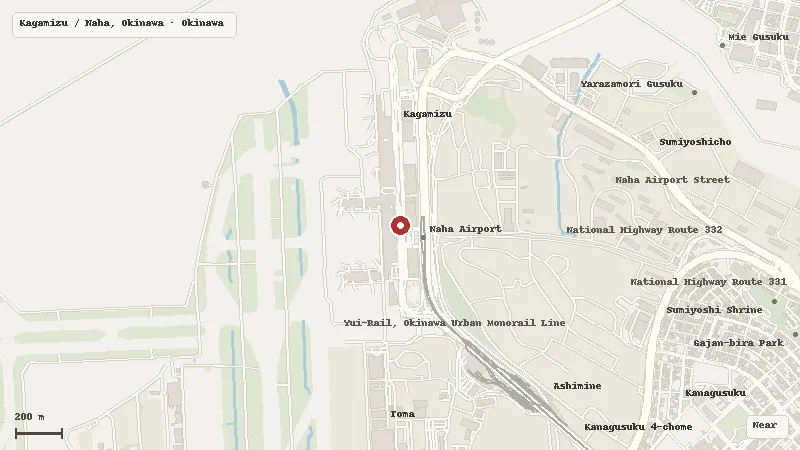
Map data © OpenStreetMap contributors