
Why we recommend it
The main traveler trap is terminal geography: a subway arrival is a Domestic Terminal arrival, so an international departure still needs the shuttle transfer across the airfield road system.
Special Visit Instructions
Some places are easy to walk into. These are not. Follow the ticket, arrival, entry and venue-specific steps below before relying on this stop in a fixed itinerary.
Confirm domestic or international terminal
The subway station is at the Domestic Terminal. International passengers need the free inter-terminal shuttle or a service that goes directly to the International Terminal.
Treat the subway as a Domestic Terminal arrival
Fukuoka Airport Station connects directly to the Domestic Terminal. Follow the International Terminal signs and free shuttle if your flight departs internationally.
Use the free shuttle and add morning margin
The airport describes the inter-terminal shuttle ride at about ten minutes and warns of heavy crowding around 08:30–09:30.
Check direct bus options before backtracking to the subway
The International Terminal has direct bus services toward Hakata, Tenjin and other Kyushu destinations. A direct bus can avoid an unnecessary terminal transfer for some journeys.
Use the Yamato counter in your Fukuoka terminal
Yamato lists pickup and shipping counters on 1F in both Fukuoka Airport’s Domestic and International terminals.
About this place
The site that became Fukuoka Airport began as Sekita Airfield, whose construction started in 1944 under the Imperial Japanese Army. After the war the airfield came under U.S. military control as Itazuke Airfield, and a 2,800-metre runway was completed in April 1951. Domestic civil service on the Tokyo–Osaka–Fukuoka route began later that year, followed by scheduled international service to Busan in 1965. The facility was transferred back to Japan and began operating as Fukuoka Airport in April 1972.
Passenger growth led to successive terminal development, including older domestic terminal buildings in 1974 and 1981 and the International Passenger Terminal in May 1999. The airport’s unusually close relationship with the city strengthened when Fukuoka Airport Station opened on the Fukuoka City Subway in March 1993. That station is attached to the Domestic Terminal, a detail that remains central to international-trip planning today. International passengers arriving by subway use the airport’s free low-floor shuttle to continue from the Domestic Terminal to the separate International Terminal.
The airport describes the domestic-to-international shuttle ride at about ten minutes and runs buses at short intervals through much of the day. It also specifically warns that the shuttle can be very crowded around 08:30–09:30, so a morning international departure needs more margin than the short nominal ride suggests. This is the main practical distinction between Fukuoka Airport’s excellent city proximity and the actual door-to-check-in journey for an international flight. The International Terminal also has direct bus services, including routes toward Hakata, Tenjin and other Kyushu destinations, which can avoid a terminal change for some itineraries.
Fukuoka Airport has continued to expand its capacity and passenger facilities. A second runway, Runway B, began operation in March 2025, and the expanded International Passenger Terminal held its grand opening in the same month. The airport states that renovation of the existing international-terminal interior was completed in December 2025, concluding the expansion project that began in 2022. Travelers using older maps or terminal descriptions should therefore rely on current airport information rather than pre-expansion layouts.
Inside the airport, information desks and accessibility services can assist with the terminal transfer, wheelchairs, strollers and onward transport questions. The combination of a subway-linked domestic terminal, a separate international terminal and direct regional buses means there is no single best ground route for every passenger. For domestic travel, the subway connection is exceptionally direct; for international travel, the shuttle or a direct International Terminal bus becomes part of the airport transfer itself. Planning Fukuoka by terminal keeps its genuine city-access advantage while avoiding the common mistake of treating the subway station and international check-in as the same building.
Planning notes
Fukuoka Airport Station connects directly with the Domestic Terminal. For international flights, follow the airport signs to the free low-floor shuttle; the airport describes the ride at about 10 minutes and currently warns of heavy crowding around 08:30–09:30. The International Terminal also has direct local and highway bus services to destinations including Hakata, Tenjin and several Kyushu cities, so the subway-plus-shuttle is not the only viable city connection. The airport completed a major International Terminal expansion and renovation in 2025, alongside the opening of the additional Runway B. Check current terminal and bus information before travel because the airport continues to develop its passenger facilities.
Yamato lists pickup and shipping counters on 1F in both Fukuoka Airport’s Domestic and International terminals.
Location
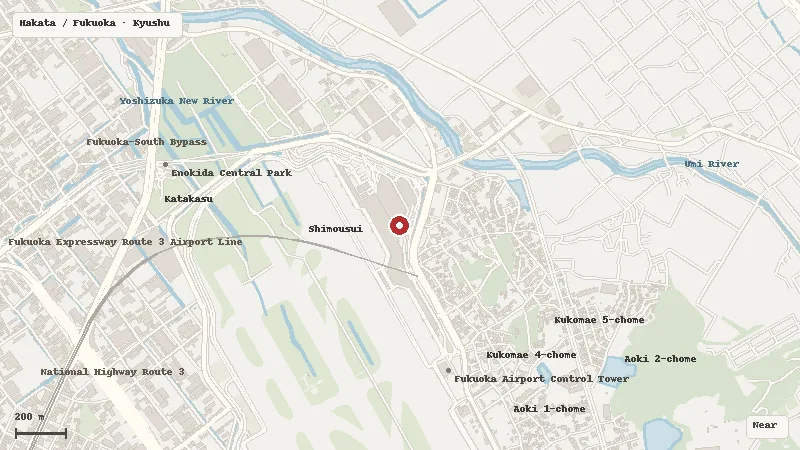
Map data © OpenStreetMap contributors