
Why we recommend it
Use this guide to plan the surface transfer first: the airport has no direct terminal rail station, so bus destination, road conditions, floor layout and construction notices matter before sightseeing begins.
Special Visit Instructions
Some places are easy to walk into. These are not. Follow the ticket, arrival, entry and venue-specific steps below before relying on this stop in a fixed itinerary.
Plan the Hiroshima Station bus as a separate leg
The airport currently lists the limousine bus to Hiroshima Station Shinkansen Gate at roughly 45–50 minutes, with actual time dependent on road conditions.
Choose the correct bus platform
Direct buses serve Hiroshima Bus Center, Fukuyama, Mihara, Takehara, Kure and Saijo as well as Hiroshima Station. Confirm the current platform before boarding.
Orient by floor
The current terminal guide places arrivals on 1F, departures on 2F, and restaurants/observation functions on 3F.
Recheck relocated or closed facilities
The airport is undergoing expansion/renovation. The International Maple Lounge is scheduled to be closed from August 17, 2026 through February 28, 2027.
Use the 1F Yamato counter at Hiroshima Airport
Yamato lists pickup and shipping service on 1F at Hiroshima Airport.
About this place
Hiroshima Airport’s present location is the result of a major relocation rather than gradual expansion at the original city airport. Hiroshima International Airport Co.’s history records that the former terminal opened in Hiroshima’s Nishi district in September 1961. The current airport at Hongo in Mihara opened on October 29, 1993, moving the principal gateway away from the built-up coastal city to a larger inland site. The current operator also records a further structural change in 2021, when integrated private operation began. Those transitions matter for visitors because “Hiroshima Airport” is geographically separate from central Hiroshima and should be planned as a surface-transfer hub rather than a city-centre station with aircraft attached.
The airport’s official address is 64-31 Zennyuji, Hongo-cho, Mihara. There is no rail station at the passenger terminal. For central Hiroshima, the airport’s current access timetable lists a limousine-bus journey to Hiroshima Station’s Shinkansen Gate at roughly 45–50 minutes, with actual time dependent on road conditions. Direct buses also connect the terminal with Hiroshima Bus Center and several regional destinations including Fukuyama, Mihara, Takehara, Kure and Saijo. Because the airport is road-dependent for these principal transfers, a rail departure in the city should not be scheduled using only the nominal bus time.
The terminal itself is comparatively easy to understand once a traveler reaches it. The current floor guide places the principal arrival functions on the first floor, departures on the second, and restaurants plus the observation area on the third. The first floor also groups practical arrival services such as information, lockers, bus-ticket functions, currency/ATM services, Wi-Fi/charging and other facilities. That compact vertical arrangement is useful after a long flight, but the onward bus still needs to be treated as the next leg of the journey rather than as an incidental connection.
The airport is presently undergoing expansion and renovation, so older terminal maps and facility assumptions can be stale. Current airport notices describe relocations and temporary changes during the work. One concrete example is the International Maple Lounge, which the operator says is closed from August 17, 2026 through February 28, 2027 because of the expansion/renovation project. Travelers relying on a specific lounge, shop or service should therefore check the current notice immediately before travel.
This guide deliberately keeps the airport-level Google Place ID and review count unresolved because the direct entity check did not expose an identity clean enough to meet the project’s map gate. The location itself is not in doubt: the official operator address, current airport site and existing airport-coordinate reference all align on the Mihara airport complex. For practical use, Hiroshima Airport should be approached in the sequence the geography demands: choose the correct bus destination, protect the road-transfer buffer, then use the compact terminal layout and current facility notices to manage the airport portion of the trip.
Planning notes
Hiroshima Airport has no rail station at the terminal. The airport’s current timetable lists the limousine bus to Hiroshima Station Shinkansen Gate at roughly 45–50 minutes, subject to road conditions.
Other direct buses serve Hiroshima Bus Center, Fukuyama, Mihara, Takehara, Kure and Saijo; confirm the correct platform before boarding.
The terminal guide places arrivals on 1F, departures on 2F, and restaurants/observation functions on 3F.
Current expansion and renovation work is relocating some facilities. The International Maple Lounge is scheduled to remain closed from August 17, 2026 through February 28, 2027, so recheck the latest airport notice before relying on it.
The exact airport address and coordinate anchor are verified, but an unambiguous airport-level Google Place ID/review entity was not established in this pass, so those fields remain unresolved.
Yamato lists pickup and shipping service on 1F at Hiroshima Airport.
Location
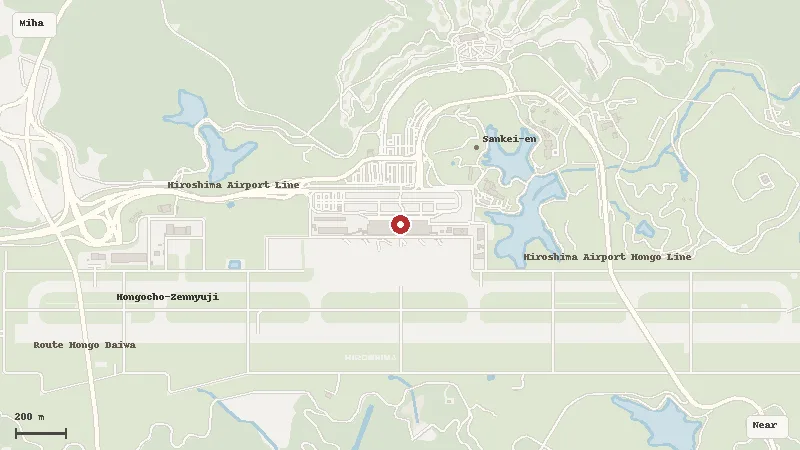
Map data © OpenStreetMap contributors